How does a mortgage work? A mortgage is a loan used to buy real estate, secured by the property itself, which is why the math and the rules around it look different from a car loan or a credit card. Once you understand the handful of moving parts underneath it, though, the whole thing stops feeling like a black box.
Understanding how a mortgage works before you apply puts you in a stronger position at every later step: what your payment is made of, the main loan types, how much home you can realistically afford, what lenders look for, and the process from application to closing.
How does a mortgage work? The basics
A mortgage lets you borrow a large sum to buy a home while the lender holds a legal claim on the property as collateral. You repay the loan, typically over 15 to 30 years, in monthly installments that include interest.
If payments stop, the lender has the right to foreclose and recover the property. That trade-off is what makes homeownership possible for people who couldn’t otherwise pay cash for a house: you get the home now, and the lender has security in case the loan isn’t repaid as agreed.
How a mortgage payment breaks down
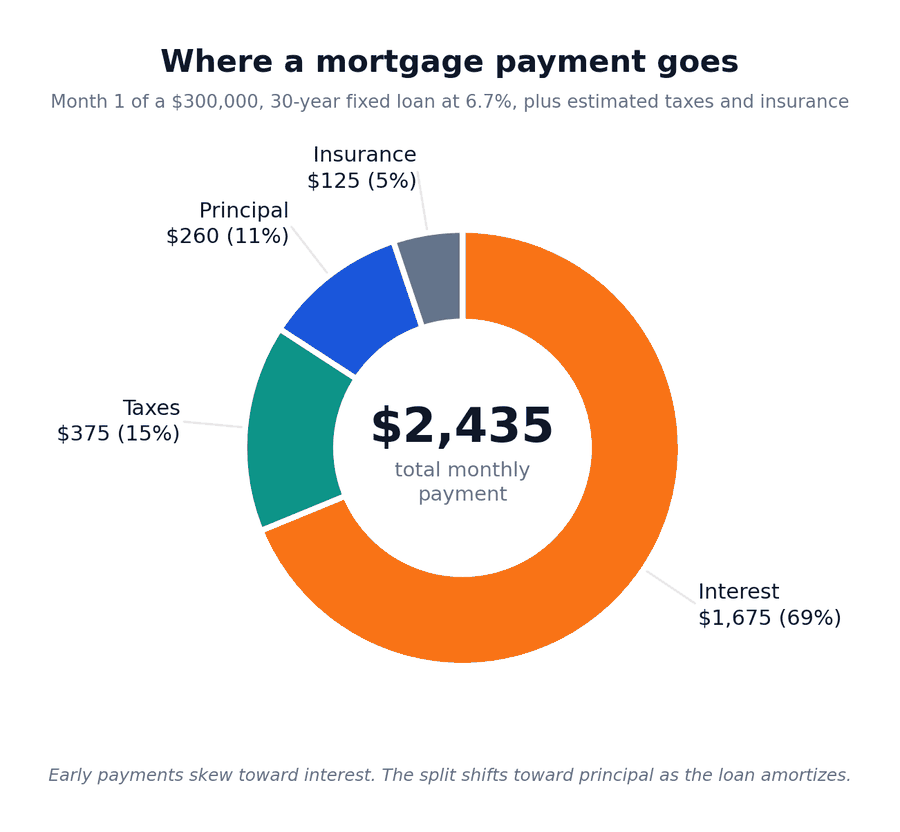
Your monthly bill is rarely just “the loan.” Most mortgage payments bundle four separate pieces together, often referred to as PITI.
- Principal. The portion that reduces your actual loan balance.
- Interest. What the lender charges for the loan. In the early years of the loan, interest makes up the larger share of each payment; that balance shifts toward principal over time, a process called amortization.
- Taxes. Property taxes are usually collected monthly through an escrow account and paid on your behalf.
- Insurance. Homeowners insurance, and private mortgage insurance (PMI) if your down payment is below 20% on a conventional loan.
If you want to see exactly how a specific loan amount, term, and rate translate into a monthly payment, along with a full year-by-year amortization schedule, the mortgage calculator handles the math for you and lets you test extra payments too.
Try it now. Estimate your full monthly payment — principal, interest, property tax, insurance, PMI and HOA — for a specific home price, down payment and rate below, with a year-by-year amortization schedule.
The main types of mortgages, compared
Not every mortgage works the same way. Picking the wrong structure for your situation is one of the more expensive mistakes a buyer can make, so it’s worth understanding the main categories before you talk to a lender.
Fixed-rate mortgages
The interest rate is locked for the entire loan term, so your principal-and-interest payment never changes. It’s the most common choice for buyers who plan to stay in the home for a long time, since it trades a potentially lower introductory rate for total predictability.
Adjustable-rate mortgages (ARMs)
An ARM starts with a lower fixed rate for an initial period, often five, seven, or ten years, then adjusts periodically based on market conditions. It can work well if you’re confident you’ll sell or refinance before the adjustment period begins, but it carries real risk if you end up staying longer than planned and rates have climbed.
FHA, VA and USDA loans
These government-backed programs exist to widen access to homeownership for specific groups of buyers. FHA loans, insured by the Federal Housing Administration, allow lower credit scores and down payments as low as 3.5%.
VA loans, guaranteed by the Department of Veterans Affairs, let eligible active-duty service members and veterans buy with no down payment. USDA loans support buyers in eligible rural areas, also frequently with no down payment required.
Jumbo loans
When a home’s price exceeds the conforming loan limits set by federal regulators, buyers need a jumbo loan. These typically require stronger credit, a larger down payment, and more cash reserves, since the lender is taking on more risk with every dollar above the conforming threshold.
| Loan type | Typical minimum down payment | Best for |
|---|---|---|
| Conventional fixed-rate | 3% to 5% | Buyers who want a predictable payment and plan to stay long-term |
| ARM | 3% to 5% | Buyers confident they’ll sell or refinance within the fixed period |
| FHA | 3.5% | Buyers with a lower credit score or limited savings |
| VA | 0% | Eligible active-duty service members and veterans |
| USDA | 0% | Buyers purchasing in eligible rural areas |
| Jumbo | 10% to 20% | Buyers financing above the conforming loan limit |
How much house can you actually afford?
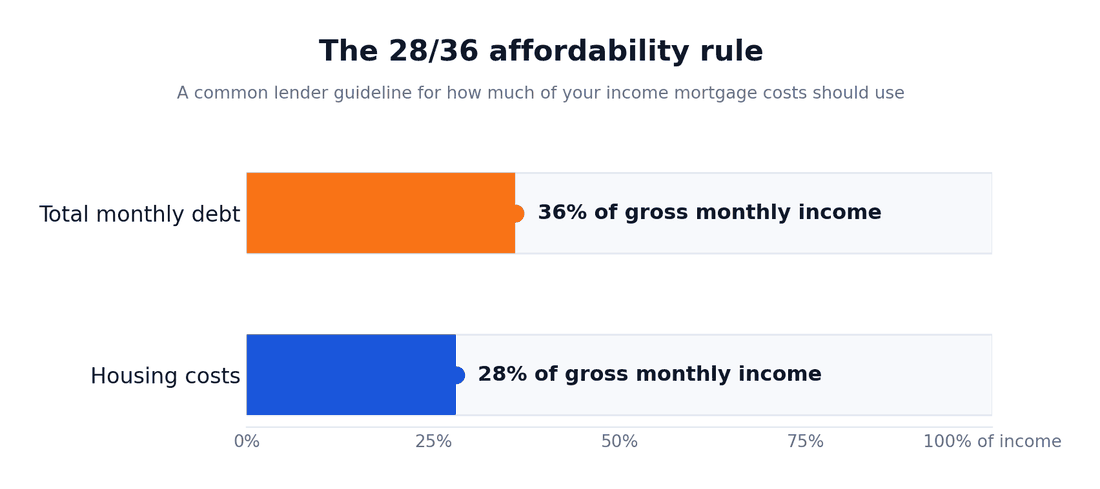
A common guideline is the 28/36 rule: housing costs shouldn’t exceed 28% of your gross monthly income, and total debt payments, including the mortgage, shouldn’t exceed 36%. Lenders will often approve you for more than this, but approved and comfortable are two different things.
Run your own numbers, factor in maintenance, utilities, and the surprise expenses that come with owning property, and decide what you can genuinely live with rather than the maximum a lender is willing to offer.
How much down payment do you really need?
“You need 20% down” is one of the most persistent myths in real estate, and it stops a lot of otherwise-ready buyers before they even start. Conventional loans can go as low as 3% down for qualified buyers, FHA loans start at 3.5%, and VA or USDA loans can require nothing down for eligible borrowers.
The tradeoff with anything below 20% on a conventional loan is private mortgage insurance, an extra monthly cost that protects the lender, not you, until you build enough equity.
Sometimes it makes more financial sense to buy sooner with a smaller down payment than to wait years on the sidelines while rents keep climbing.
What credit score do you need for a mortgage?
Your credit score functions like a financial reputation you carry into every lending conversation, and it can swing your interest rate by a full percentage point or more. Conventional loans typically want to see a score of 620 or higher, though the best rates go to borrowers north of 740.
FHA loans open the door as low as 580, and sometimes even 500 with a larger down payment. Even a modest score bump, say from 660 to 700, can shave real money off your monthly payment.
If your score needs work before you apply, our guide to improving your credit score walks through the fastest legitimate ways to move it.
The mortgage application process, step by step
Knowing the theory is one thing. Walking through the actual process without feeling lost is another.
Pre-qualification vs. pre-approval
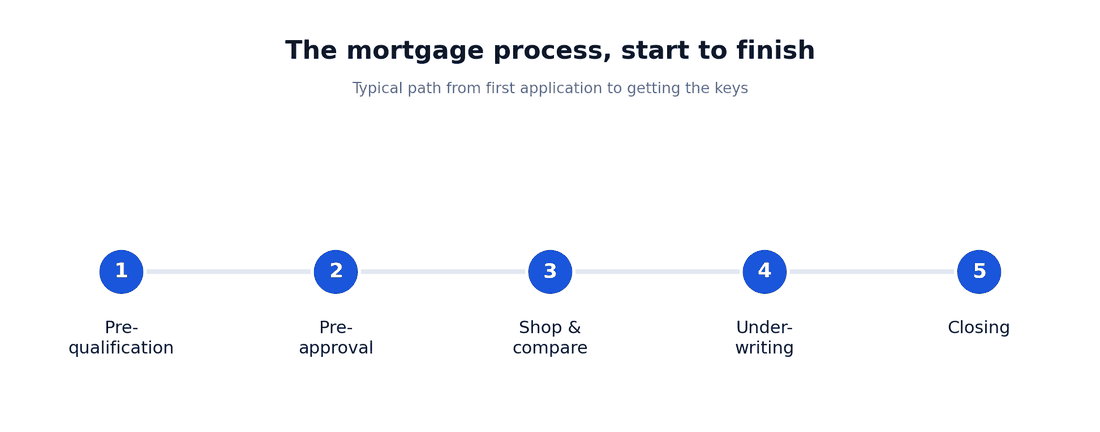
Pre-qualification is a quick, informal estimate based on self-reported information, useful for window-shopping but carrying little weight with sellers. Pre-approval is the real deal: a lender verifies your income, assets, and credit, then issues a conditional commitment for a specific loan amount.
In a competitive housing market, showing up with a pre-approval letter instead of a pre-qualification signals you’re a serious buyer.
Choosing a lender and comparing offers
Compare rates, fees, and service across banks, credit unions, and online lenders rather than accepting the first offer you get. A quarter-point difference in rate can add up to thousands of dollars over the life of the loan.
Ask every lender for a Loan Estimate, a standardized form required by federal law that makes comparing offers apples-to-apples. Run a few different rate scenarios through the mortgage calculator before you talk to anyone, so you already know what a given rate and term would cost you. For a benchmark, Freddie Mac publishes average 30-year and 15-year fixed rates every week in its Primary Mortgage Market Survey.
Underwriting and closing
Once you’ve submitted your application, an underwriter reviews your income, assets, appraisal, and title to confirm the loan is sound. It can feel invasive, but it exists to protect everyone in the transaction.
Once underwriting clears, you move to closing, where you sign the final documents, pay closing costs, and receive the keys.
Closing costs: the expense first-time buyers forget to budget for
Closing costs typically run 2% to 5% of the loan amount, due on top of your down payment, not instead of it. They cover appraisal fees, title insurance, origination fees, attorney fees, recording fees, and prepaid items like homeowners insurance and property taxes.
On a $350,000 loan, that could mean anywhere from $7,000 to $17,500 due at the closing table. Budgeting for this early prevents the scramble that happens when buyers realize, days before closing, that they’re short on cash.
Fixed vs. adjustable: how to choose
This decision comes down to one honest question: how long do you plan to stay in this home? If your answer is indefinitely, a fixed-rate mortgage gives you stability that’s hard to put a price on.
If you know you’ll move or refinance within five to seven years, an ARM’s lower initial rate could save you real money, provided you’re disciplined about your exit timeline. An ARM is, in a sense, a bet on your own life plans holding steady, and life doesn’t always cooperate. That’s worth sitting with before you sign anything.
Refinancing: when it actually makes sense
Refinancing means replacing your existing mortgage with a new one, usually to get a lower rate, shorten your term, or tap into home equity. It isn’t automatically a win just because rates have dipped a little since you bought.
A useful rule of thumb: refinancing tends to make sense when the new rate is at least 0.5 to 1 percentage point lower than your current one, and you plan to stay in the home long enough to recoup the closing costs through your monthly savings. Calculate your break-even point, the number of months it takes for your savings to offset the refinancing costs, before you commit.
If you’re planning to sell within that window, refinancing probably isn’t worth the hassle or the fees. Run the new rate and term through the mortgage calculator to see the real payment difference, and if you’re refinancing specifically to pull cash out of your equity rather than to lower your rate, compare that against a home equity loan first. A HELOC or home equity loan leaves your original low-rate mortgage untouched, which is often the cheaper path if your current rate is well below what’s available today.
Common mistakes first-time buyers make
A few missteps trip up buyer after buyer, and most are entirely avoidable with a little foresight. Shopping with only one lender leaves real savings on the table. Making large purchases or opening new credit lines during the loan process can tank your approval odds right before closing.
Skipping the home inspection to seem more competitive, underestimating ongoing costs like maintenance and property taxes, and draining every last dollar of savings for the down payment cause just as much damage.
None of these mistakes are fatal on their own, but stacked together, they turn what should be an exciting milestone into a stressful scramble.
Tips to strengthen your mortgage application
Pull your credit report months in advance and dispute any errors you find. Pay down revolving debt to lower your debt-to-income ratio, avoid switching jobs right before applying, and keep your financial life uneventful in the months leading up to your application: no new credit cards, no large unexplained deposits, no co-signing for someone else’s loan.
Lenders reward predictability, so the goal is to look as financially boring as possible right when it counts.
Mortgage trends worth knowing in 2026
First-time buyers are, on average, older than previous generations, because home prices have outpaced wage growth for years now. Many are leaning more heavily on down payment assistance programs, gifted funds from family, and government-backed loan products to bridge the gap.
Lenders have also expanded digital application tools, cutting the paperwork burden and speeding up approval timelines.
Before you talk to a lender, run your own numbers with the mortgage calculator to see what a given rate, term and down payment would cost you each month. And if your credit score needs a boost before you apply, our guide to improving your credit score covers the fastest legitimate ways to move it.
Frequently asked questions
What credit score do I need to qualify for a mortgage?
Conventional loans typically require a minimum of 620, FHA loans can go as low as 580 (or even 500 with a larger down payment), and the best rates generally go to borrowers with scores above 740.
How much down payment do I actually need to buy a home?
It depends on the loan type. Conventional loans can start at 3% down, FHA loans at 3.5%, and VA or USDA loans may require nothing down for eligible borrowers.
What’s the difference between pre-qualification and pre-approval?
Pre-qualification is an informal estimate based on self-reported numbers. Pre-approval involves verified documentation and carries real weight with sellers in a competitive market.
Is it better to choose a fixed-rate or adjustable-rate mortgage?
Fixed-rate loans offer payment stability for the life of the loan. ARMs offer a lower initial rate that can benefit buyers who plan to move or refinance within a set number of years, but carry more risk if plans change.
How much are closing costs on a mortgage?
Closing costs typically range from 2% to 5% of the total loan amount and are due in addition to your down payment.
What is PMI, and do I always have to pay it?
Private mortgage insurance protects the lender when your down payment is below 20% on a conventional loan. It generally isn’t required on VA loans, and FHA loans handle mortgage insurance under different terms.
How long does the mortgage approval process usually take?
From application to closing, the process typically takes 30 to 45 days, though strong documentation and digital lenders can sometimes speed this up.
Can I get a mortgage with a high debt-to-income ratio?
It’s possible, but most lenders prefer a total debt-to-income ratio under 36% to 43%. Higher ratios may require compensating factors like strong credit or larger cash reserves.
This article is for general educational purposes and does not constitute financial or legal advice. Mortgage rates, qualification requirements, and program details vary by lender and change over time. For guidance specific to your situation, consider speaking with a licensed mortgage professional or financial advisor.
Related guides
- Mortgage calculator: estimate your full monthly payment with taxes, insurance, PMI and HOA, plus an amortization schedule
- Mortgage calculator: estimate your monthly payment and full amortization schedule
- Improve your credit score: move up a pricing tier before you apply
- Understanding your credit score: how it’s calculated and what it means for loan pricing
- Home equity loans: borrowing against a home you already own
- Debt consolidation: combining balances into one payment
Last updated: August 2026. Program details and thresholds cited on this page (minimum credit scores, down payment minimums, closing cost ranges) reflect typical market conditions as of August 2026 and are subject to change by individual lenders.