An installment loan isn’t a kind of loan. It’s a way of paying one back. That one detail is why it usually beats a payday loan: a typical payday fee of $15 per $100 borrowed works out to an APR of almost 400%, according to the CFPB, and it’s due in full on your next payday.
This page is for anyone weighing a payday loan, a cash advance or an installment loan to cover a gap of a few hundred to a few thousand dollars. By the end you’ll know what an installment loan costs, how to read an offer, which red flags to walk away from, and whether you need a loan at all.
What is an installment loan?
An installment loan is money you borrow once and repay in equal, scheduled payments, usually monthly, over a set term. Each payment covers part of the interest and part of the balance, so the loan is fully paid off on the last payment.
Most loans you’ve heard of work this way. Personal loans, auto loans, mortgages and student loans are all installment loans. What changes between them is the amount, the term, and whether something like a car or a house backs the loan.
Three numbers define every installment loan:
- Principal: the amount you borrow.
- APR: the yearly cost of borrowing, including interest and most fees, as a percentage.
- Term: how many months you have to pay it off.
Get those three numbers from any offer before you look at anything else. The monthly payment follows from them.
Installment loan vs. payday loan vs. cash advance vs. credit card
The real difference between these options is how you pay them back. Installment loans spread the cost over months. Payday loans and cash advances want everything back at once, which is why so many borrowers end up paying fees to push the due date.
| Installment loan | Payday loan | Cash advance (credit card) | Credit card purchase | |
|---|---|---|---|---|
| How you repay | Fixed monthly payments until paid off | Full amount plus fee, usually in 2 to 4 weeks | Revolving; minimum payments | Revolving; minimum payments |
| Typical cost | Varies widely with credit, from single digits to over 100% APR in some states | About 400% APR on a two-week loan (CFPB) | Card’s cash APR plus an upfront fee; interest starts immediately | Card’s purchase APR; no interest if paid in full by the due date |
| Credit needed | Fair to good for mainstream rates; some lenders take lower scores at higher rates | Usually just income and a bank account | An existing card with available credit | An existing card with available credit |
| Time to repay | Usually 6 to 60 months | One pay period | Open-ended | Open-ended |
| Main risk | High APR from some lenders; long terms add interest | Rollovers that pile fees on the same balance | High cost that compounds on an open balance | Minimum payments that drag the balance on for years |
If a lump-sum repayment would empty your next paycheck, an installment loan is almost always the safer structure. The structure is only half of it, though. The price still depends on the APR.
How installment loans work
You borrow a fixed amount, the lender sets an APR and a term, and you pay the same amount every month until the balance hits zero. Early payments go mostly to interest. Later ones go mostly to the balance. That schedule is called amortization.
A few terms worth knowing before you sign:
An origination fee is a one-time charge that’s often taken out of the loan before you get the money. Borrow $1,000 with a 5% fee and $950 lands in your account, but you still repay $1,000 plus interest.
A secured loan is backed by something the lender can take if you stop paying, like a car title. An unsecured loan isn’t. Secured loans can come with lower rates, but you’re putting the asset on the line. Our secured vs. unsecured loans guide covers that trade-off.
A prepayment penalty is a fee for paying the loan off early. Many lenders don’t charge one. Ask before you sign, because paying early is one of the easiest ways to cut the total cost.
How to get an installment loan through Loans.net
- Fill in one request with how much you need, what it’s for and basic details about your income. It takes a few minutes and costs nothing.
- When you submit, a soft credit check runs. It doesn’t affect your credit score.
- Your request goes to our lender network, where lenders’ systems review it automatically.
- A matched lender contacts you directly. Loans.net is a marketplace, not a lender, and we don’t make sales calls. The lender sets the rate and terms and makes the approval decision.
- Before you accept, check the APR, the total repayment amount and any fees against other offers you have. You’re under no obligation to accept.
What installment loans cost
What you’ll pay depends mostly on your credit and the lender. Mainstream lenders reserve their lowest rates for strong credit, fair credit pays noticeably more, and some high-cost lenders charge well over 100% APR in states that allow it.
Here’s a rough picture of how rates tend to spread by credit profile. These ranges are illustrative, not quotes:
| Credit profile | Illustrative APR range |
|---|---|
| Good to excellent | About 8% to 18% |
| Fair | About 18% to 30% |
| Poor | About 30% to 36%, or much higher from high-cost lenders |
Rates are illustrative. Your actual rate depends on your credit profile, income and the lender.
A useful line to hold: 36%. Federal law caps the cost of most consumer credit to active-duty service members and their families at a 36% military APR under the Military Lending Act, and the Department of Defense’s 2015 rule extended that protection to installment loans. Civilians don’t get that cap nationwide, but it’s a solid benchmark. An offer well above 36% deserves a hard second look.
Your credit score and history usually weigh the most. After that, lenders look at your debt-to-income ratio (how much of your monthly income already goes to debt payments), how steady and verifiable your income is, and whether the loan is secured. The term matters too: longer terms often carry higher rates, and they always mean more months of interest.
The term trap works like this. Say you borrow $1,000 at 30%. Over 12 months the payment is about $97 and you pay about $170 in interest. Stretch it to 24 months and the payment drops to about $56, but the interest nearly doubles to about $342. Pick the shortest term you can cover in a bad month, not a good one.
See what you would actually be offered. One request goes to our lender network, and the soft credit check at submit won’t affect your score.
Worked example: a $1,000 emergency, three ways
Your car needs a $1,000 repair and payday is two weeks away. Here’s what the same $1,000 costs under three options. All rates are illustrative.
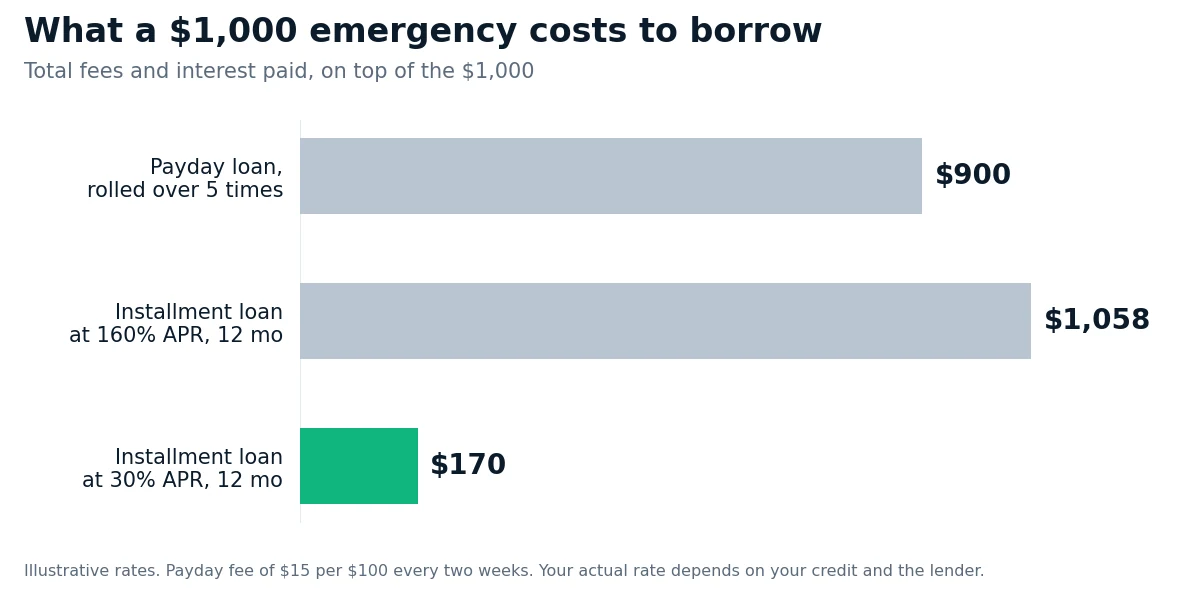
Option 1: A payday loan you keep rolling over. At $15 per $100, the fee is $150 every two weeks. You can’t cover the full $1,000 on payday, so you pay the $150 and roll it over. After five rollovers you finally pay it off at week 12. That’s six fees, or $900, on top of the $1,000, plus the risk of the whole balance coming due on any payday.
Option 2: A high-cost installment loan at 160% APR over 12 months. The payment is about $172 a month. There’s no balloon payment, but over the year you pay about $1,058 in interest, more than the loan itself.
Option 3: An installment loan at 30% APR over 12 months. The payment is about $97 a month, and the total interest is about $170.
| Payday, 5 rollovers | Installment at 160% | Installment at 30% | |
|---|---|---|---|
| Monthly or per-period cost | $150 every 2 weeks | About $172/month | About $97/month |
| Total cost of borrowing | $900 | About $1,058 | About $170 |
| Total repaid | $1,900 | About $2,058 | About $1,170 |
The high-cost installment loan beats the payday loan on structure: no balloon payment, predictable payments. But it costs more in total, because you’re paying a very high rate for a full year. The difference between Option 2 and Option 3 is about $888, and it comes down to one number: the APR.
Rates are illustrative. Your actual rate depends on your credit profile and the lender.
So don’t stop at “installment.” Get the APR and the total repayment amount in writing, and compare two or three offers side by side.
Can you get an installment loan with bad credit?
Yes. Some lenders approve borrowers with poor credit, but the rate will be higher and the amount may be smaller. That’s exactly where comparing offers matters most, because the spread between lenders is widest for lower scores.
Three things improve your odds and your rate: a steady income you can document, a lower debt-to-income ratio, and a co-signer with better credit if you have one. Our bad credit loans guide goes through the approval side in detail.
Is an installment loan right for you?
An installment loan makes sense when the expense is real, you can’t cover it from savings, and the monthly payment fits your budget in a bad month. It’s a poor fit when the payment would squeeze you so hard you’d need to borrow again next month.
It’s probably a good fit if:
- You need a specific amount for a specific expense, like a car repair or a medical bill.
- You can cover the payment even in a tight month.
- The APR you’re offered is lower than the alternatives, like a payday loan or a cash advance on a card.
- You’d otherwise be tempted to roll over a payday loan.
It’s probably not right if:
- You’re borrowing to cover everyday bills that keep coming up short. A loan moves that gap to next month and adds interest.
- The only offers you’re getting are far above 36% APR. Look at the alternatives below first.
- You’d need to take a new loan to make this loan’s payments.
Before you apply, write down the largest monthly payment you could make in your worst month of the last year. Treat that number as your ceiling.
Red flags: how to spot a predatory lender
The biggest red flag is a lender asking for money before you get money. A legitimate lender deducts fees from the loan or adds them to the balance. It never asks for a prepaid fee, a gift card or a wire transfer to “unlock” your loan, and the FTC warns that this is how advance-fee loan scams work.
Walk away if you also see any of these:
- A promise of “guaranteed approval.” No legitimate lender can guarantee approval before reviewing your application.
- “No credit check” as the main selling point. It usually means the lender charges enough to cover the risk of not checking.
- Pressure to sign today. A real offer is still there tomorrow.
- Repeated offers to refinance before the loan is paid off. Some high-cost lenders do this to reset the fees and keep you paying.
- Credit insurance or “membership” fees you didn’t ask for, rolled into the balance.
- An APR that’s missing or hard to find. Lenders are required to disclose it, so if they won’t show it clearly, don’t sign.
If something feels off, you can check a lender’s licensing with your state’s financial regulator before you sign anything.
How an installment loan affects your credit score
In the short term, an installment loan can dip your score by a few points. When you complete an application with a lender, it usually runs a hard credit check. The new account also lowers the average age of your accounts.
Over the long term, it can help. Payment history is the biggest factor in FICO scores, so a year of on-time payments builds your record. Adding an installment loan to a credit history made up only of cards can also improve your mix of credit.
Late payments cut the other way. A payment that’s 30 or more days late can be reported to the credit bureaus and stay on your report for up to seven years. Set up automatic payments on the day your paycheck lands and that risk mostly goes away.
Alternatives to an installment loan
The cheapest loan is often the one you don’t take. Before you borrow, check whether one of these covers the gap for less.
A credit union payday alternative loan (PAL) is the closest match. Under NCUA rules, federal credit unions can offer small loans at no more than 28% APR, plus an application fee of up to $20. PAL I loans run $200 to $1,000 over one to six months, and PAL II loans go up to $2,000 over up to 12 months. You’ll usually need to be a member.
Some employers will advance part of your pay at little or no cost, so it’s worth asking HR. Hospitals, utilities and many repair shops will also split a bill into payments if you ask before it’s past due.
If loans keep feeling like the only option, a nonprofit credit counselor can review your whole budget and may set up a debt management plan. Our debt consolidation guide explains how those plans work.
If you do need a loan, the personal loans guide covers larger amounts and borrowers with stronger credit.
Frequently asked questions
Is a personal loan an installment loan?
Yes. A personal loan is repaid in fixed monthly payments over a set term, which makes it an installment loan. Auto loans, mortgages and student loans are installment loans too.
Are installment loans better than payday loans?
Usually, yes, because you repay over months instead of all at once. But the APR decides the real cost. A high-cost installment loan can cost more over a year than a short payday loan, so compare the total repayment amount, not just the payment.
Can I get an installment loan with bad credit?
Yes, some lenders work with bad credit, usually at higher rates and smaller amounts. Comparing several offers matters most in this range, because the difference between lenders is widest.
Does checking offers through Loans.net hurt my credit?
No. Submitting a request runs a soft credit check, which doesn’t affect your score. A lender will usually run a hard check if you move forward with its offer.
How fast can I get the money?
It depends on the lender. Many online lenders fund within one to a few business days after approval, and some faster. The lender will tell you its timeline before you accept.
Does it cost anything to use Loans.net?
No. Submitting a request is free, and you’re never obligated to accept an offer. Your costs are the interest and any fees in the loan you choose, which the lender must disclose before you sign.
What happens if I miss a payment?
Most lenders charge a late fee, and a payment 30 or more days late can be reported to the credit bureaus. If you know a payment will be late, call the lender before the due date. Many will offer a short extension or a new payment date.
How old do I have to be to get an installment loan?
You need to be at least 18 in most states, and a little older in a few. Lenders also typically require a US address, a bank account and a verifiable source of income.
Related guides
- Personal loans
- Bad credit loans
- Cash advance and payday loans
- Secured vs. unsecured loans
- Debt consolidation
- Loan calculator
Ready to compare? Submitting a request is free, there’s no obligation to accept, and Loans.net never makes sales calls.
Loans.net is a loan marketplace, not a lender. We don’t make loan decisions or set rates. Submitting a request connects you with lenders in our network, and Loans.net may be compensated by those lenders. All rates and figures on this page are illustrative examples; your actual rate and terms depend on your credit profile and the lender. This page is general information, not financial advice.
Last reviewed: September 2026.