Your credit score follows you into almost every major financial decision you’ll make in the U.S.: the interest rate on a car loan, whether a landlord approves your apartment application, even some job background checks. That’s why it pays to improve your credit score before you need it.
If your number is lower than you’d like, the good news is that a credit score is not a fixed judgment of your character. It’s a mathematical snapshot of your borrowing behavior, and behavior can change.
This guide walks through exactly how to improve your credit score, what to do first if you’re trying to fix bad credit quickly, and which habits keep your score high once you get there.
Why your credit score matters more than you think
A 100-point difference in your credit score can mean tens of thousands of dollars over the life of a mortgage, simply because of the interest rate you qualify for. Auto lenders, credit card issuers, cell phone carriers, and even some insurance companies in the U.S.
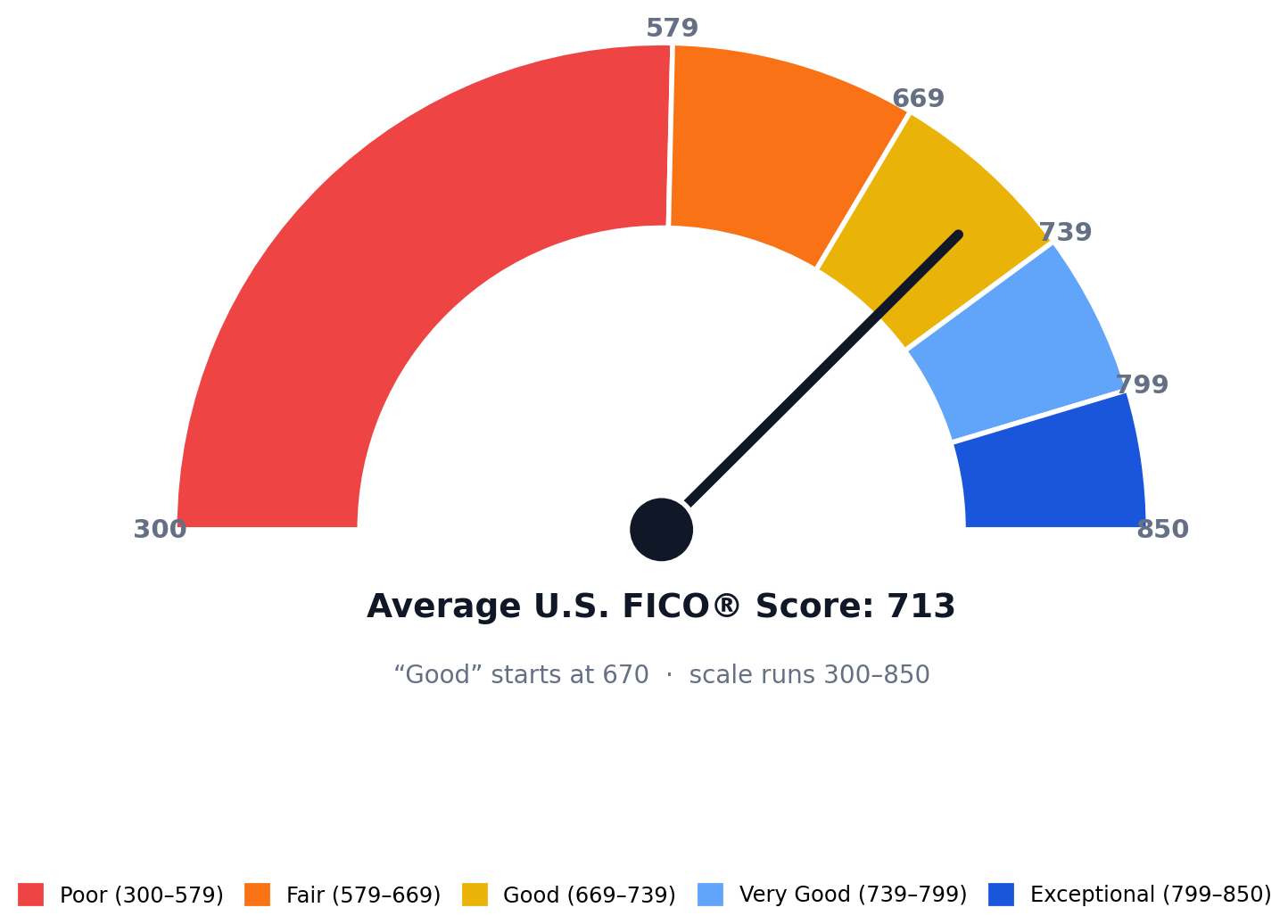
use your score, or the data behind it, to decide what they’ll offer you and at what price. The average FICO Score in the U.S. currently sits at 713, which falls in the “good” range, but a large share of borrowers sit below that line and pay more for credit as a result.
Improving your score isn’t about chasing a perfect number; it’s about crossing the thresholds lenders actually use to price risk.
How credit scores actually work: the 5 factors behind your number
Most U.S. lenders rely on FICO Scores, VantageScore, or both. The exact formulas are proprietary, but FICO has published the weight of each factor for years, and understanding them is the fastest way to know where to focus your effort.
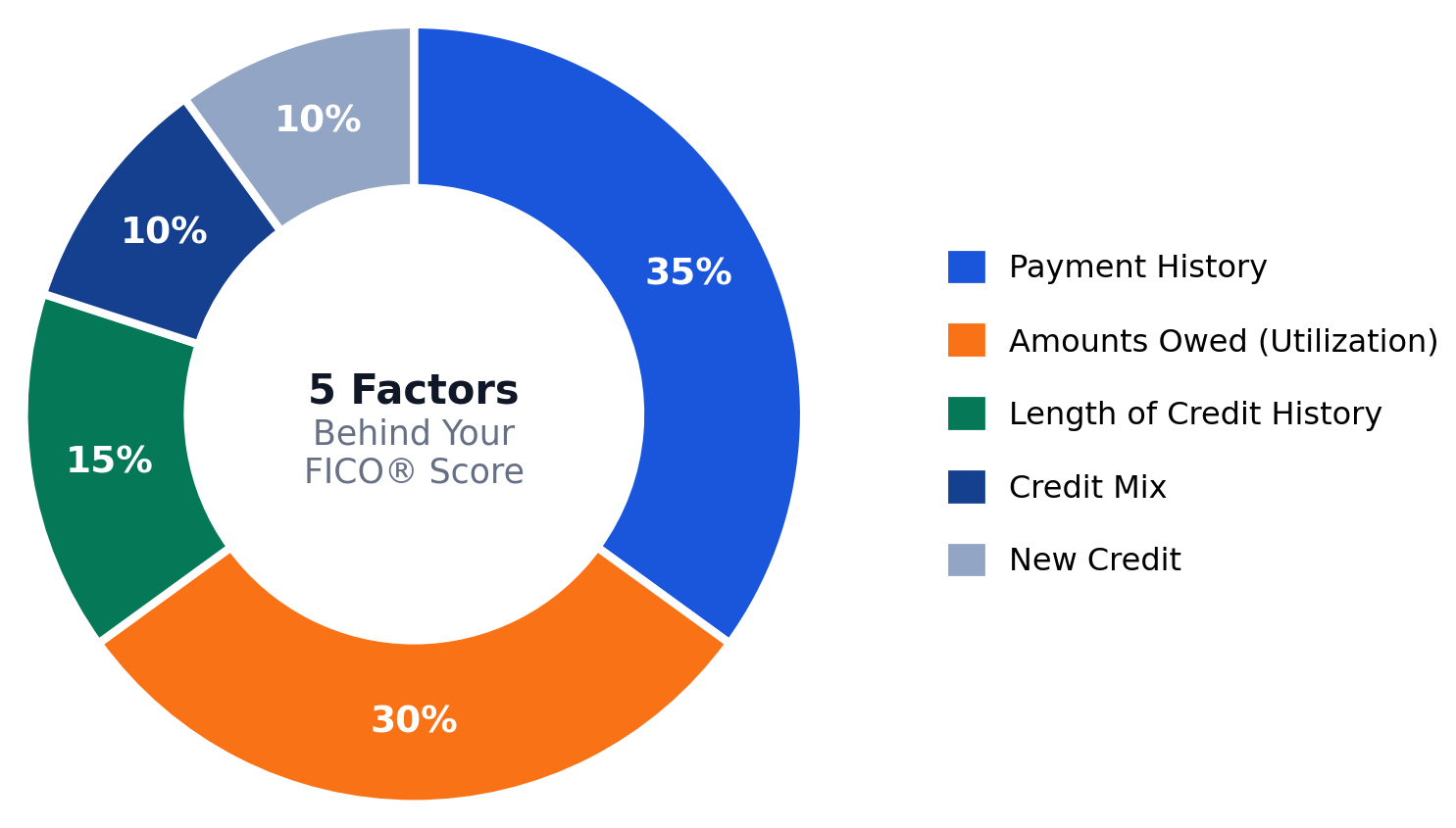
- Payment history (35%). Whether you’ve paid your bills on time. This is the single biggest lever you control, and it’s also the slowest to move, since late payments can stay on your report for up to seven years.
- Amounts owed, or credit utilization (30%). How much of your available revolving credit you’re using. This factor reacts fast, which is exactly why it’s the best tool when you’re trying to fix bad credit quickly.
- Length of credit history (15%). The age of your oldest account and the average age of all your accounts. This is why closing your oldest credit card can quietly hurt you even if you never use it.
- Credit mix (10%). Whether you manage a combination of revolving credit (cards) and installment credit (loans) responsibly.
- New credit (10%). How many accounts you’ve opened recently and how many hard inquiries appear on your report.
Two of these five factors, utilization and payment history, account for nearly two-thirds of your score. That’s where most of the strategies below are aimed.
What counts as a good credit score in 2026?
FICO Score 8, the version most widely used by U.S. lenders, breaks down like this:
| Range | Category |
|---|---|
| 300-579 | Poor |
| 580-669 | Fair |
| 670-739 | Good |
| 740-799 | Very Good |
| 800-850 | Exceptional |
Roughly 71% of Americans now fall in the “good” range or better. If you’re below 670, you’re not alone, and the steps below apply directly to you. If you’re already in the “good” range, the long-term habits section will help you push toward “very good,” where the best mortgage and auto rates typically start.
For what each range means in dollars on a real loan, and how FICO and VantageScore label them, see our guide to credit score ranges.
How to fix bad credit quickly: 7 steps that actually move the needle
“Quickly” needs an honest caveat up front: nothing legitimate erases years of history overnight, and any company promising to remove accurate negative information for a fee is not a shortcut.
It’s a warning sign. What you can do quickly is correct errors, lower your utilization, and stop new damage from accumulating. For most people, that’s enough to see real movement within one to three billing cycles.
1. Pull your free credit reports and dispute errors
Every U.S. consumer is entitled to a free credit report from Experian, Equifax, and TransUnion every week through AnnualCreditReport.com. This access became permanent in 2023, so there’s no reason to pay for a report or a credit monitoring subscription just to see your own file.
Studies have consistently found that a meaningful share of credit reports contain errors: an account that isn’t yours, a payment marked late that was actually on time, or a balance that’s outdated.
Under the Fair Credit Reporting Act (FCRA), you have the right to dispute inaccurate information directly with the bureau (the CFPB explains how), and the bureau generally has 30 days to investigate. Removing even one inaccurate negative item can produce a fast, real score increase, and this is the highest-leverage first step for almost everyone.
2. Pay down credit card balances first
Because utilization is 30% of your score and reacts within a single billing cycle, this is usually the fastest lever available. Card issuers typically report your balance to the bureaus once a month, on your statement date, not your due date.
Paying a card down (or paying it off entirely) before that statement closes, rather than just before the due date, can lower the utilization number that actually gets reported.
Most credit experts point to keeping utilization under 30% as a reasonable target, and under 10% for people optimizing toward the “very good” or “exceptional” range.
3. Become an authorized user on a healthy account
If a family member has a credit card in good standing with a long history and low utilization, being added as an authorized user can let that account’s positive history appear on your report.
It won’t work miracles, and it depends on the card issuer actually reporting authorized-user data to the bureaus (most major issuers do), but it’s a legitimate way to add positive history quickly, particularly for people with thin credit files.
4. Ask for a goodwill adjustment
If you have a generally strong payment history with one late slip-up (a bill you paid a few days late during a rough month), it’s worth calling the lender or card issuer and asking for a “goodwill deletion” of that single late mark.
Lenders aren’t obligated to do this, and it works better with smaller lenders and credit unions than large banks, but it costs nothing to ask and occasionally succeeds.
5. Open a secured credit card or credit-builder loan
If your file is thin or your score is low enough that you don’t qualify for a standard card, a secured credit card (backed by a refundable deposit you set yourself, often $200 to $500) or a credit-builder loan from a credit union reports payment history to the bureaus just like any other product.
Used responsibly, with small charges paid in full every month, these are one of the most reliable ways to build a positive payment history from scratch.
6. Handle collections strategically
If you have accounts in collections, understand your options before you pay. A “pay-for-delete” agreement (asking the collector to remove the item once paid, in writing, before you pay) isn’t guaranteed but is worth requesting.
Under current bureau policy, paid medical collections are removed from your report entirely, and unpaid medical collections under $500 don’t get reported at all, so check whether a medical collection even qualifies before you spend money resolving it.
For non-medical collections, know that paying an old debt can sometimes restart the reporting clock in some circumstances, so it’s worth understanding the debt’s age and your state’s statute of limitations before acting.
If you’re juggling several accounts in collections at once, it may also be worth comparing what a debt consolidation loan would cost against continuing to pay each one separately.
7. Time your applications, and consider rapid rescoring if you’re closing on a loan
Each hard inquiry from a new credit application can shave a few points off your score and stays on your report for two years, though its effect fades well before that. If you’re actively working to fix bad credit quickly ahead of a mortgage or auto loan, avoid opening new accounts in the months beforehand.
If you’re already in underwriting and a dispute or paydown hasn’t updated on your report yet, ask your loan officer about a rapid rescore, a paid service lenders can use to get updated data reflected in days rather than the usual 30-to-45-day cycle.
How long does it really take to improve your credit score?
Timelines vary by starting point and what’s dragging your score down, but here’s a realistic range. Correcting a report error is often reflected within 30 to 45 days of a successful dispute.
Lowering utilization can show up on your very next statement cycle, often the fastest visible change available. A single late payment fades in impact meaningfully within a few months if no further damage occurs, though it stays on your report for up to seven years.
Rebuilding after a collection, charge-off, or bankruptcy realistically takes twelve to twenty-four months of consistent on-time payments, not the few weeks that some “credit repair” services promise.
Be skeptical of any service that guarantees a specific point increase by a specific date. No legitimate company can promise that, because your score depends on data reported by multiple lenders they don’t control.
Long-term habits that keep your score high
Fixing bad credit quickly gets you out of a hole. These habits keep you out of it:
- Automate at least the minimum payment on every account so a forgotten due date never becomes a 30-day-late mark, which is the most damaging single event for most credit files.
- Keep old accounts open, even ones you rarely use, since closing them shortens your average account age and can raise your utilization ratio by shrinking your total available credit.
- Space out new credit applications rather than applying for several cards or loans in a short window.
- Check your reports regularly. The free weekly reports from AnnualCreditReport.com make this easy, and catching an error or fraudulent account early limits the damage.
- Diversify responsibly. A mix of a credit card and an installment loan (auto, personal, or student) managed well tends to score better than credit cards alone, though this factor matters far less than payment history and utilization.
Medical debt and your credit report: what changed
If you’ve heard that medical debt was removed from credit reports altogether, that’s only partly accurate as of 2026. A federal rule from the Consumer Financial Protection Bureau that would have banned medical debt from credit reports nationwide was vacated by a federal court in 2025 and is not currently in effect.
However, the major bureaus (Experian, Equifax, and TransUnion) still voluntarily follow protections they adopted in 2022-2023: paid medical collections are removed from reports, unpaid medical collections under $500 are not reported at all, and any medical collection must be at least a year old before it can appear.
On top of that, several states (including California, Colorado, Illinois, New York, and Virginia, among others) have passed their own laws restricting medical debt reporting more strictly than federal policy requires.
If medical debt is affecting your score, check both the bureau policy and your state’s rules before assuming it can’t be removed.
Common credit repair mistakes to avoid
- Closing your oldest card to “simplify” your finances often does more harm than good.
- Paying off collections without a plan. Understand pay-for-delete options and reporting rules first.
- Applying for multiple cards or loans at once to try to fix things faster typically works against you.
- Ignoring your credit reports until you need a loan. Errors are far easier to fix with time on your side.
- Paying for “credit repair” companies that promise guaranteed results. Anything a paid company can legally do, such as disputing errors or requesting goodwill adjustments, you can do yourself for free.
Free tools to track your progress
- AnnualCreditReport.com. Free weekly reports from all three bureaus, permanently, direct from the source (avoid look-alike sites that charge fees).
- Your card issuer’s app. Most major U.S. issuers now show a free FICO or VantageScore estimate.
- Loans.net’s credit score resources. For a closer look at how your score is calculated and what it means for the loan products you may qualify for, see our credit score guide.
Once your score is moving in the right direction, it’s worth knowing what it actually qualifies you for. You can compare pre-qualified personal loan offers on Loans.net. Checking uses a soft credit inquiry and won’t affect your score.
Frequently asked questions
How fast can I improve my credit score?
It depends what’s holding it back. Correcting a report error or lowering credit card utilization can show measurable movement within one to two billing cycles. Recovering from a collection, charge-off, or bankruptcy realistically takes twelve months or more of consistent on-time payments.
What’s the single most effective way to improve credit score numbers?
For most people, it’s a close call between disputing report errors and lowering credit utilization. Both can produce visible movement fast because they correct or change data that’s actively being reported, rather than waiting for old negative marks to age off.
Does checking my own credit score hurt it?
No. Checking your own report or score is a “soft inquiry” and has no effect on your score. Only “hard inquiries,” which happen when you apply for new credit, can cause a small, temporary dip.
Can I remove accurate negative information from my credit report?
Not through legitimate means. You can dispute inaccurate or unverifiable information, and you can sometimes negotiate a goodwill deletion or a pay-for-delete agreement on a debt you owe, but accurate, verifiable negative information can generally stay on your report for the timeframe set by law (typically seven years for most negative items).
Is a credit repair company worth paying for?
Usually not. Credit repair companies primarily do what you’re legally entitled to do yourself for free: dispute inaccurate items and request goodwill adjustments. Be especially cautious of any company that asks for payment before doing any work or guarantees a specific outcome; both practices violate the Credit Repair Organizations Act.
This article is for general educational purposes and does not constitute financial, legal, or credit counseling advice. Credit scoring models, timelines, and outcomes vary by individual circumstances and by lender.
For guidance specific to your situation, consider speaking with a nonprofit credit counselor (such as one accredited by the National Foundation for Credit Counseling) or a qualified financial advisor.
Related guides
- Understanding your credit score: how it’s calculated and what it means for loan pricing
- Debt consolidation: combining balances into one payment
- Personal loans: compare pre-qualified offers
- Loans for bad credit: what’s realistic below a 630 score
- Loan calculator: estimate your monthly payment and total interest
Last updated: August 2026. Statistics cited on this page (FICO Score 8 ranges, average U.S. score, medical debt reporting rules) were verified against current sources as of August 2026 and are subject to change.