Two neighbors on the same street each need $12,000 in the same month. One has a roof that won’t make it through another winter. The other is tired of juggling four credit card bills.
Both compare personal loans online, and both get approved at about the same rate.
The first neighbor takes the offer with the lowest monthly payment, spread over seven years. It feels like the careful choice. The second takes four years, the shortest term she could still pay in a bad month.
For a long time nothing separates them. Both pay on time, and neither thinks much about the loan.
In the third year, a bad month arrives: a hospital bill, or fewer hours at work. The neighbor on the four-year loan is most of the way through it by then, and she has some room in her budget. The one on the seven-year loan is still paying for the roof, and will be for four more years.
They had the same rate and the same approval. What separated them was the term, and nobody at the lender asked either of them to think about it.
A personal loan is a rate, a term and a monthly payment. The payment is the part you have to keep making in your worst month, so that’s the part to choose carefully.
This page is for anyone in the U.S. comparing personal loans. It covers what personal loan rates usually look like, what moves the rate a lender quotes you, how the term changes what you pay in total, and when a personal loan is the wrong tool.
Loans.net is not a lender. We’re a marketplace. You send one short request, lenders in our network review it, and the ones that can help contact you directly. Checking uses a soft credit pull, so your score doesn’t move.
Start with one short request
Tell us how much you need and what it’s for. Lenders in our network that can help will contact you directly.
Compare Personal Loan Offers
What is a personal loan?
A personal loan is money you borrow once, as a lump sum, and pay back in equal monthly payments over a fixed term. The rate is usually fixed, so the payment in the first month is the payment in the last. Most personal loans are unsecured, which means you don’t put up your car or your house. The lender looks at your credit history and your income instead.
The easiest way to see what that means is to put it next to a credit card.
Two people each owe $8,000. One carries it on a credit card. The other moves it into a personal loan. The card asks for a minimum payment that shifts with the balance and has no end date, so the debt can sit there for years while the minimum mostly covers interest. The loan has a payment that doesn’t change and a last payment date printed in the contract.
The two debts are the same size. Only one of them is built to end.
The rates usually differ too. In the second quarter of 2026, the Federal Reserve put the average rate on credit card accounts at 20.94%, and the average rate on a 24-month personal loan at a commercial bank at 11.86% (Federal Reserve G.19, released September 8, 2026).
You can use a personal loan for almost anything: paying off credit cards, a repair, a medical bill, a move across the country. Many lenders won’t fund tuition, investing or gambling, and most will ask what the money is for when you apply.
More people are borrowing this way. Americans held $281 billion in unsecured personal loan balances in the second quarter of 2026, up 9.6% from a year earlier, according to TransUnion’s Q2 2026 Credit Industry Insights Report.
Personal loan rates: what to expect and what moves yours
Two people apply for the same $12,000 loan on the same afternoon. One is quoted a rate under 10%. The other is quoted something close to 30%.
Neither of them did anything different that day. The lender is pricing what it can see in each file: years of payment history, how much of each paycheck already goes to other debts, how steady the income has been. Then it adds a guess about the years it can’t see.
Your personal loan rate is the lender’s estimate of how likely you are to pay the loan back, based on what your file shows today.
What rates look like
For traditional installment lenders, personal loan APRs in the U.S. run from roughly 6% to 36%. The Federal Reserve’s benchmark is the average rate on a 24-month personal loan at a commercial bank, and it was 11.86% in the second quarter of 2026. Online lenders spread wider in both directions.
Our lender network is broad. It includes companies that offer high-cost short-term credit priced well above 36%, in some cases at triple-digit APRs. Those products are legal and their terms are disclosed to you, but they are expensive, and they are a different product from the loans in the table below. Whatever offer reaches you, find its APR and read it before you accept.
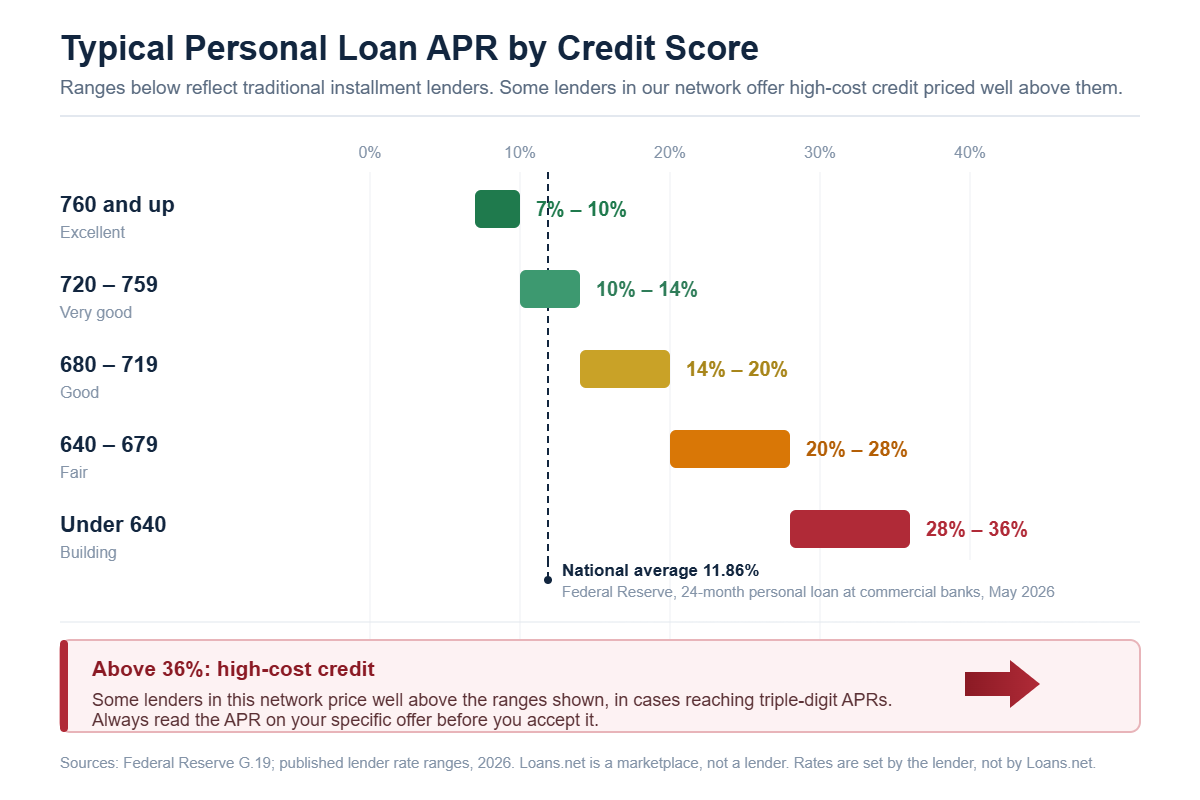
| Credit score | Typical APR range | What it usually means |
|---|---|---|
| 760 and up | about 7% to 10% | Lenders compete for you. Compare origination fees as closely as rates. |
| 720 to 759 | about 10% to 14% | Strong offers are common. A co-signer rarely changes much here. |
| 680 to 719 | about 14% to 20% | The term starts to matter. The shortest one you can afford usually costs least. |
| 640 to 679 | about 20% to 28% | Offers vary widely in this band, so comparing pays off most here. |
| Under 640 | about 28% to 36% | A secured loan, a co-signer or a credit union may price better. |
What moves the rate you’re quoted
Most of your rate comes from your history. Your credit score does the most work, and within the score, payment history counts the most.
Then comes your present. Lenders look at how much of your gross monthly income already goes to debt payments, which is called your debt-to-income ratio. The higher that share, the less room they see for one more payment. They also look at how steady your income is. Two years with one employer tends to read better than the same money from gig work that changes month to month.
The loan itself matters too. Shorter terms usually carry lower rates. Very small and very large loans can both price higher than amounts in the middle. And many lenders charge an origination fee, taken out of the loan before the money reaches you.
That fee is why you compare APR instead of the interest rate. APR includes the fee and the interest rate doesn’t. Say you need $12,000 in hand for three years. A 12% loan with a 6% fee means borrowing about $12,766 to receive $12,000. You’d pay about $424 a month and about $15,264 in total. A 14% loan with no fee costs about $410 a month and $14,765 in total. The loan with the lower rate costs about $500 more.
Illustrative example. Your actual rate and fees depend on your credit profile and the lender.
How we calculate these rates
The ranges above combine two sources. One is the Federal Reserve’s G.19 Consumer Credit release, which reports the average rate banks charge on 24-month personal loans. The other is the APR ranges that lenders publish. We review these figures periodically. They are market benchmarks, not a quote, and your rate is set only when a lender underwrites your application. To estimate a monthly payment first, try our loan calculator.
The table is the market. Your rate is yours.
Averages can’t tell you what a lender will offer you. A two-minute request can, and it won’t touch your credit score.
Check my rateLong-term vs. short-term personal loans: what the term costs you
Go back to the two neighbors, this time with numbers attached. Say both are approved for $12,000 at 14% APR.
The neighbor who chose seven years (84 months) pays $224.88 a month. The neighbor who chose four years (48 months) pays $327.92. The shorter loan costs about $103 more each month, and in the first year that feels like a lot.
By the end, the picture flips. The 84-month loan costs $6,889.93 in interest. The 48-month loan costs $3,740.05. The lower payment ends up costing about $3,150 more.
Then comes the bad month in year three. After 36 payments, the four-year neighbor owes about $3,652. The seven-year neighbor still owes about $8,229, more than two thirds of the original loan.
| Term | Monthly payment | Total interest | Total paid |
|---|---|---|---|
| 36 months | $410.13 | $2,764.74 | $14,764.74 |
| 48 months | $327.92 | $3,740.05 | $15,740.05 |
| 60 months | $279.22 | $4,753.14 | $16,753.14 |
| 84 months | $224.88 | $6,889.93 | $18,889.93 |
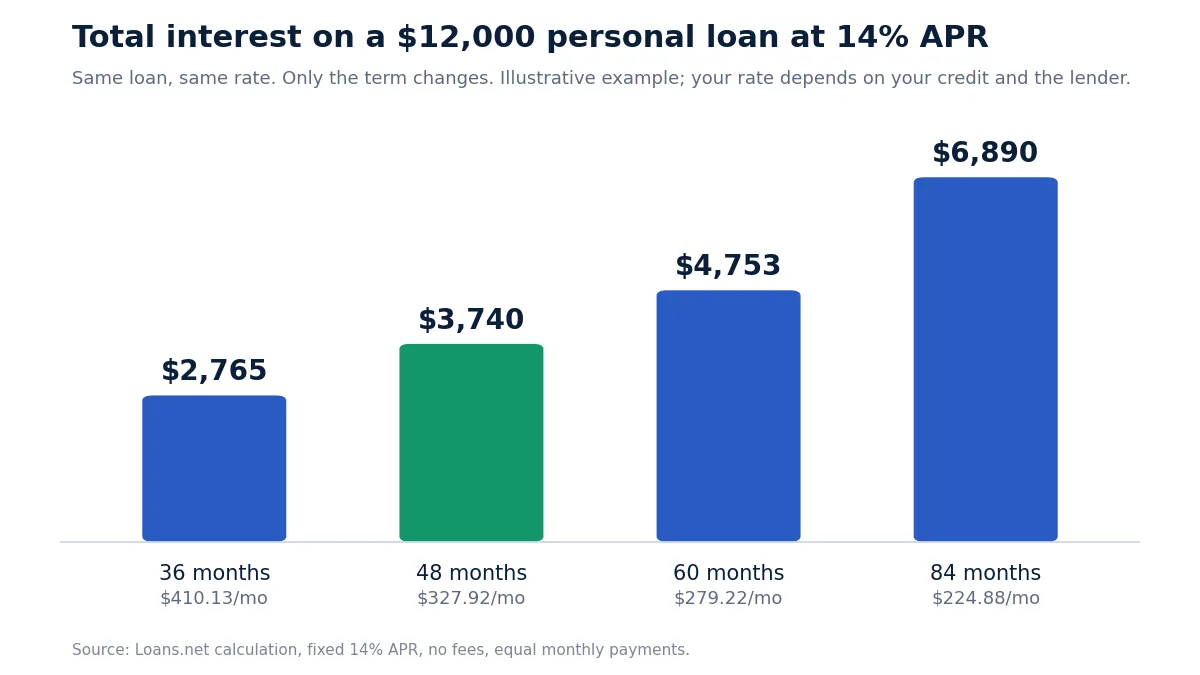
A longer term lowers your monthly payment and raises the total cost of the loan. You pay for every extra year in interest.
That doesn’t make a long-term personal loan a mistake. The monthly payment is what you have to cover in your worst month, and sometimes the shorter term leaves no slack at all. A payment that only works in a good month isn’t really affordable.
There’s a middle path when the lender allows it: take the longer term, then pay extra in the months you can. Paying $327.92 a month on the seven-year loan above would clear it in 48 months, the same as the four-year loan. The required payment stays low for the bad months, and the total cost falls as long as you keep up the extra payments. Before you count on this, check the contract for a prepayment penalty and confirm that extra payments go toward principal.
The right term is the shortest one whose payment you could still make in a bad month.
Personal loan vs. other ways to borrow
Two people can need the same money and be better served by different tools. Someone with $6,000 of card debt they can clear within a year may pay less with a 0% balance transfer card. A homeowner with plenty of equity and a large project may pay less with a home equity line. A personal loan sits between them: a fixed payment, a set end date, and nothing tied to your house.
The best way to borrow depends on how long you need the money and what you’re willing to put at risk.
| Option | Typical cost | Credit usually needed | How you repay | Main risk |
|---|---|---|---|---|
| Personal loan | Fixed APR, roughly 6% to 36% at traditional lenders | Fair to excellent; some lenders work with lower scores | Equal monthly payments over a set term | Choosing a longer term than you need |
| 0% balance transfer card | 0% during an intro period, usually plus a transfer fee | Good to excellent | Whatever you pay; the regular card rate applies after the intro period | A balance left over when the intro period ends |
| Home equity line (HELOC) | Variable rate, often lower than unsecured loans | Good, plus equity in your home | Interest-only draw period, then principal and interest | Your home secures the debt |
| Credit union loan | Federal credit unions are generally capped at 18% APR | Membership required; underwriting is often flexible | Equal monthly payments | Fewer choices if you’re not a member |
| Cash advance (payday) | A typical $15 per $100 fee for two weeks is an APR of almost 400% | Often no traditional credit check | One payment on your next payday | Rolling it over and paying the fee again |
If you’re weighing a short-term option, our cash advance guide covers how those fees add up, and our home equity guide covers borrowing against your house.
What people use personal loans for
Most people don’t take out a personal loan because they want one. Something already happened, or is about to.
Paying off credit cards. This is the most common reason, and often the most useful one. Moving several card balances into one fixed payment at a lower rate can save real money and gives the debt an end date. Compare the total interest, not only the monthly payment. Our debt consolidation guide walks through the math.
Home repairs. A roof, a furnace, a water heater. A personal loan doesn’t need an appraisal and doesn’t put a lien on your house. It usually costs more than borrowing against your home, so you’re paying for speed and for keeping the house out of it.
Medical bills. Call the billing office first and ask about an interest-free payment plan. Many providers offer one without advertising it. If that doesn’t work, a personal loan usually costs less than carrying the bill on a card.
Big planned costs. A move, a wedding, an adoption, a funeral. They’re large, one-time and predictable, which is the shape an installment loan fits best.
Emergencies. A transmission, an emergency vet bill, an insurance deductible. This is where people get hurt most, because the fastest option on offer is often a payday loan. If you have any credit history, check personal loan options first.
Vehicles auto lenders won’t finance. Private-party sales, older cars, motorcycles. See our car loan guide first, since a loan secured by the vehicle usually costs less.
A personal loan works best for a one-time cost you can name, with a payoff date you can see.
Know what you need it for? Start there.
Tell us the amount and the purpose. Lenders in our network review your request, and the ones that can help contact you directly.
Check my optionsSecured vs. unsecured personal loans
Two borrowers with the same thin credit file apply for the same amount. One offers a paid-off car as collateral. The other offers nothing. The first will often get a lower rate and a longer term, because the lender’s risk is smaller. The second keeps the car out of it and pays for that in a higher rate.
An unsecured personal loan rests on your credit and income alone. A secured personal loan is backed by something you own, like a car, a savings account or a certificate of deposit. If you stop paying a secured loan, the lender can take the collateral.
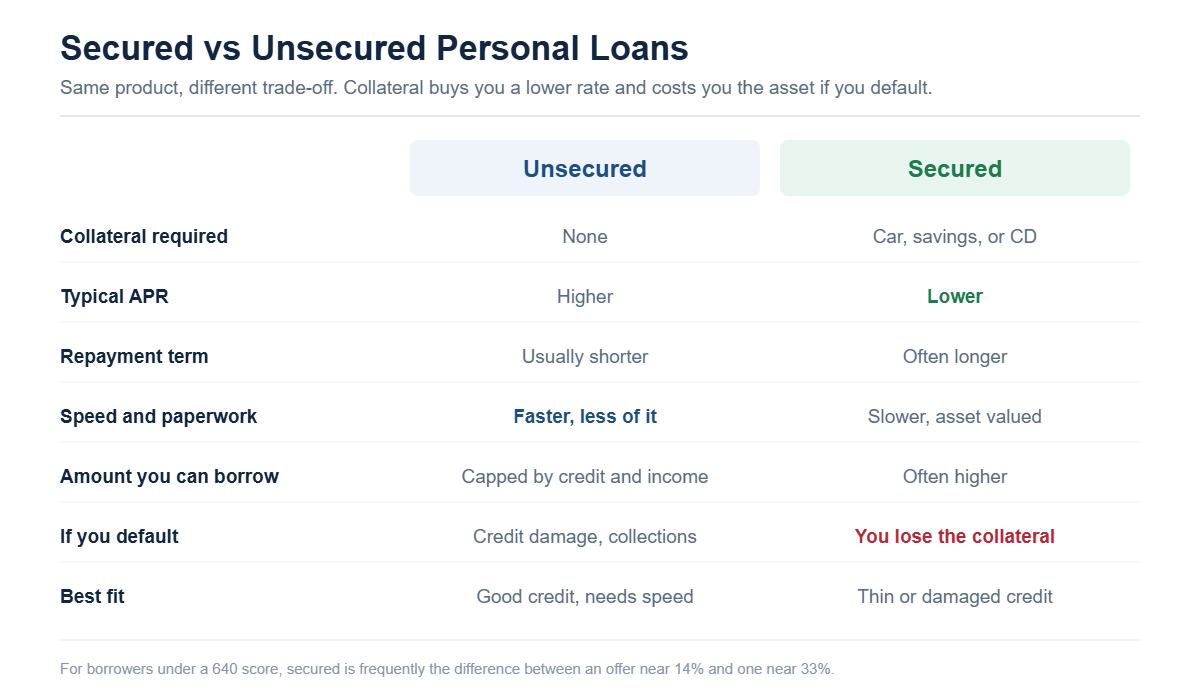
A secured loan lowers the rate by putting something you own on the line; an unsecured loan keeps your assets safe and costs more. If your credit is thin or damaged, it’s worth comparing both. Our secured vs. unsecured guide and bad credit loan guide go deeper.
How to get a personal loan through Loans.net
Loans.net matches your request with lenders. The lender makes the offer and the decision. Here’s what happens:
- Send one short request. The amount, what it’s for, and the basics: name, address, date of birth, income and employment. It takes about two minutes, with no documents to upload.
- Lenders review it. Your request goes to lenders in our network, whose systems review it automatically. A soft credit check runs when you submit, and it doesn’t affect your score.
- A lender contacts you. If a lender can make you an offer, that lender contacts you directly with its terms. Compare the APR, monthly payment, term and fees before you accept anything. If you go ahead, the lender will usually run a hard credit check and verify your income, so keep pay stubs and bank statements handy.
Not every request gets an offer, and Loans.net doesn’t make sales calls. Most lenders ask that you be at least 18 (19 in Alabama and Nebraska), with a U.S. address, income you can verify and a checking account in your name. Income from self-employment, retirement or benefits counts with many lenders.
Before you apply anywhere, pull your free credit reports from Equifax, TransUnion and Experian at AnnualCreditReport.com. Fixing a wrong late payment can move you into a better rate tier.
Meet the basics? Send your request.
18 or older, a U.S. address, steady income and a checking account in your name are usually enough to get started.
Start my requestIs a personal loan right for you?
A lender’s approval answers one question: whether it thinks you’ll pay the loan back. It doesn’t answer whether you should borrow. That one is yours.
A personal loan usually makes sense when the cost is one-time, the rate is lower than what you’re paying now, and the payment would still fit in a bad month. It works well for card debt if you’ve also stopped adding to the cards.
It usually doesn’t make sense when the money would cover a gap that repeats every month, since a loan pushes that gap into next year with interest on top. The same goes when the payment only works if everything goes right, or when you could wait a few months and save instead.
If the answer is no, a nonprofit credit counselor can help you build a plan, including a debt management plan that may lower your card rates without a new loan. You can find one through the National Foundation for Credit Counseling. We would rather lose the referral than put you in a debt you can’t carry.
Borrow when the loan ends a problem. Don’t borrow when it only moves the problem to next year.
Red flags: how to spot a personal loan scam
The people most likely to be targeted by a loan scam are the ones who need money quickly and have been turned down elsewhere. The warning signs are consistent:
- A fee before you get the loan. The FTC notes that it’s illegal for telemarketers to promise you a loan and ask you to pay up front, before they deliver it.
- Guaranteed approval before anyone has looked at your credit or income.
- Payment by gift card, wire transfer or cryptocurrency.
- Pressure to sign today, or an offer that expires within the hour.
- No APR in writing. Federal law requires lenders to disclose the APR and finance charge before you sign.
- No physical address, or a lender you can’t find licensed or registered in your state.
Loans.net never asks you for money and never calls you. A lender that contacts you after your request should tell you who it is and put its terms in writing.
A legitimate lender shows you the APR before you sign and never asks you to pay to get the loan. You can report suspected fraud at ReportFraud.ftc.gov.
How a personal loan affects your credit score
Checking through Loans.net uses a soft inquiry, which only you can see and which doesn’t affect your score.
When you formally apply with a lender, it usually runs a hard inquiry. According to myFICO, one additional inquiry takes less than five points off most people’s FICO Scores. A new account also lowers the average age of your accounts a little.
After that, the loan works in your favor if you pay on time. Each on-time payment adds to your payment history. If you used the loan to pay off credit cards, your card utilization drops, which often helps your score more than the new account hurt it. A payment more than 30 days late is the part that does real damage, so set up autopay if you can.
A personal loan usually costs a few points at the start and helps over time, as long as every payment is on time. Our guides to credit scores and improving your credit cover the rest.
Personal loan FAQ
Does checking my rate on Loans.net hurt my credit score?
No. Loans.net uses a soft credit inquiry, which only you can see and which has no effect on your score. A hard inquiry happens only if you choose to apply formally with a lender.
What credit score do I need for a personal loan?
There is no single minimum. Scores of 640 and up usually get more competitive rates, and 720 and up get the best ones. Some lenders work with lower scores at higher rates, and a secured loan or a co-signer can help.
Are long-term personal loans a good idea?
They lower the monthly payment but raise the total cost. On a $12,000 loan at 14% APR, an 84-month term costs about $6,890 in interest, compared with about $3,740 over 48 months. Choose the shortest term whose payment you could still make in a bad month.
What is a good APR on a personal loan?
It depends on your credit. As a benchmark, the Federal Reserve reported an average rate of 11.86% on 24-month personal loans at commercial banks in the second quarter of 2026. Borrowers with strong credit often see lower rates, and borrowers with weaker credit see higher ones.
How long are personal loan terms?
Terms vary by lender. Many personal loans run from about two to seven years, and a shorter term usually means a higher payment but less total interest. Choose the shortest term whose payment you could still make in a bad month.
How fast can I get the money?
The request takes about two minutes. Once a lender approves you and verifies your details, funds often arrive within one to five business days, depending on the lender and your bank.
Is Loans.net free, and how does it make money?
Sending a request is free. Loans.net is compensated by participating lenders and partners, and the arrangements vary by partner. Lenders set their own rates and terms, and any origination fee they charge must be included in the APR they disclose to you.
What if I can’t make a payment?
Call the lender before the due date. Many offer a short grace period, a new due date or a hardship plan, but those options are harder to get once an account is past due. Most lenders don’t report a late payment to the credit bureaus until it is 30 days late.
Have a question we didn’t cover? See our full FAQ page.
Related guides
- Debt consolidation loans
- Personal loans for bad credit
- Installment loans
- Secured vs. unsecured loans
- Car loans
- What your credit score means
- Loan calculator

Ready to compare?
One short request. Lenders in our network that can help contact you directly. No effect on your credit score.
Compare Personal Loan OffersWritten and reviewed by Zion Rokah, founder, Loans.net Network Ltd · Last reviewed 30 September 2026 · How we source and check this
Important Disclosures
Loans.net is a marketplace and is not a lender. We do not make credit decisions, set rates, or fund loans. We pass your request to participating third-party lenders and lending partners, and a lender that can make you an offer contacts you directly.
Rates, fees, loan amounts, and repayment terms are set by the lender, not by Loans.net, and vary based on your creditworthiness, income, loan purpose, and state of residence. The APR and all fees applicable to your loan are disclosed to you by the lender before you commit. Not all applicants qualify, and not every request receives an offer. All loans are subject to the lender’s underwriting and approval.
Our lender network includes providers of high-cost short-term credit whose APRs may substantially exceed the ranges shown on this page, in some cases reaching triple digits. Rate figures on this page are third-party market data from the Federal Reserve and published lender ranges, or illustrative examples, provided for general comparison only. They are not offers of credit.
Sending a request through Loans.net is free. Loans.net is compensated by participating lenders and partners, and compensation arrangements vary by partner. Lenders set their own rates and terms.
Submitting a request uses a soft credit inquiry, which does not affect your credit score; applying with a lender may result in a hard inquiry. Funding times are estimates and depend on lender verification and your bank. Not available in all states.