Written and reviewed by Yonni Rossa
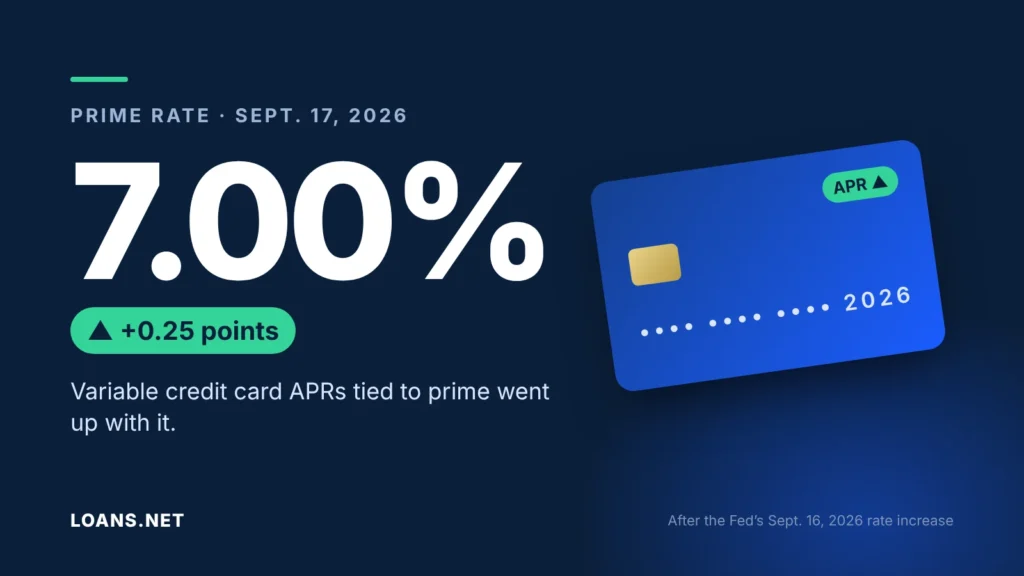
The prime rate rose to 7.00% on September 17, 2026, the day after the Federal Reserve raised its benchmark range by a quarter point to 3.75% to 4.00%. On October 7, the minutes of that meeting showed most Fed officials expect another increase “would likely be appropriate” by year end.
The short answer for your credit card: if it has a variable APR tied to the prime rate, your rate went up 0.25 percentage points, and the issuer didn’t have to send a letter first. On a $5,000 balance, that hike alone costs about $12.50 a year. The hike is not your problem. The rate it was added to is.
What the prime rate hike does to your credit card
Americans have a strange custom of paying 20-something percent interest on last spring’s purchases and calling it “carrying a balance.”
Many card agreements set the APR as the prime rate plus a fixed margin, so when prime moves, your rate moves with it. Under the CFPB’s Regulation Z, an issuer doesn’t owe you the usual 45 days’ notice when an increase comes from a public index like prime. The new rate shows up on your statement, and that is the notice.
The arithmetic on the September move:
- $5,000 balance × 0.25 percentage points = $12.50 more interest per year
- That works out to about $1.04 a month
A dollar a month is not worth losing sleep over. But the Fed minutes point to more increases, and the margin your card charges on top of prime never goes away. The number worth your attention is the full rate, not the latest bump.
The real cost of a $5,000 balance
Take a $5,000 card balance at an example APR of 24%, pay $200 a month and add no new charges. Clearing it takes 36 months and about $2,001 in interest.
Now nudge the rate:
- At 24.25% (one quarter-point hike), interest comes to about $2,034, or $33 more over three years
- At 24.75% (three quarter-point hikes), it’s about $2,102, roughly $101 more
Drop the payment to $150 a month at 24%, though, and payoff stretches to 56 months with about $3,322 in interest. In that version you pay back two-thirds of what you originally spent, just in interest.
Each Fed hike adds pocket change. Paying slowly at a high base rate adds real money. Fix the second and the first barely matters.
Rates in these examples are illustrative, not offers. Your actual rate depends on your credit profile and the lender.
When a debt consolidation loan beats the card
A debt consolidation loan is a fixed-rate installment loan you use to pay off card balances. The rate is set for the life of the loan, so future prime-rate moves don’t touch it, and you get one payment with an end date.
Here is the same $5,000 over 36 months, four ways (illustrative rates):
| Option | Monthly payment | Total interest and fees |
|---|---|---|
| Card at 24%, paying $200 | $200 | about $2,001 |
| Loan at 14%, no fee | about $171 | about $1,152 |
| Loan at 14%, 5% origination fee | about $180 | about $1,476 |
| Loan at 20%, no fee | about $186 | about $1,689 |
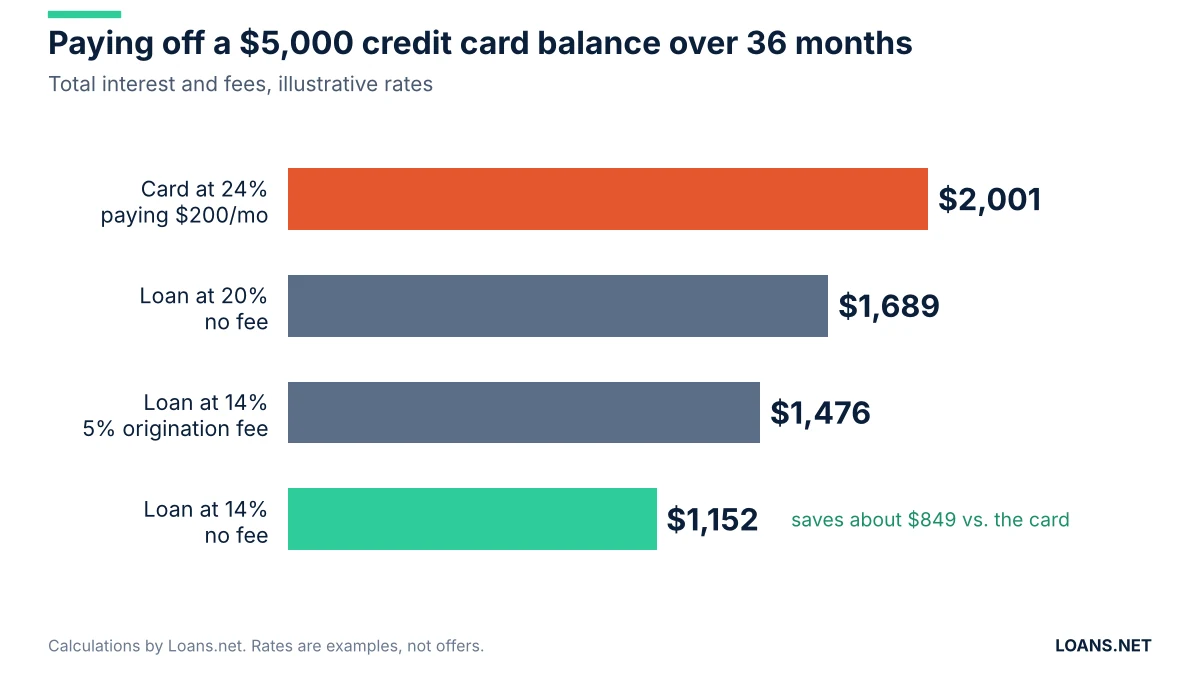
At 14% with no fee, you save about $849 and your payment drops by about $29. Add a 5% fee (you’d borrow about $5,263 so that $5,000 lands on the card) and the savings shrink to about $525. At 20%, you save around $312, and a fee could eat most of that.
Consolidation pays off when the new APR, fee included, is clearly lower than your card rate. A couple of points lower usually isn’t enough once fees come in. Compare APRs rather than advertised interest rates, because the APR folds in the origination fee.
What this means for you
- Check your statement. Find the APR and the line that explains how it’s set, often “Prime + X%.” The X is the part you can negotiate or escape.
- Call your issuer and ask for a lower rate. It costs nothing, and customers with a record of on-time payments sometimes get a yes.
- Pay above the minimum. Going from $150 to $200 a month in the $5,000 example saves about $1,321 in interest and 20 months.
- Price a fixed-rate loan only if it’s clearly cheaper. If you have fair or bad credit and the offers come back near your card rate, skip it. You’d be trading one debt for another at the same price.
- Don’t run the card back up. A consolidation loan plus a refilled card is twice the debt. If you can’t stop using the card, deal with that first.
- If you can clear the balance in a few months, just do that. A loan for a balance you’ll finish by spring adds paperwork and possibly fees for very little.
If you’re not sure where you stand, read how your credit score affects the rates you’re offered, run your own numbers in the loan calculator, or see our guide to debt consolidation.
Your homework this week: pull your latest card statement, write down the APR and the balance, and multiply them. That’s roughly your yearly interest bill if nothing changes. Then decide whether that number deserves a plan.
Compare your options
If your card APR went up again this fall, see whether a fixed-rate consolidation loan would cost you less.
Loans.net is a marketplace, not a lender. Checking offers uses a soft credit check. Loans.net is paid by partners.
FAQ
Does the prime rate affect my credit card rate?
Yes, if your card has a variable APR tied to prime. Those rates are usually the prime rate plus a margin, so when prime rose to 7.00% on September 17, 2026, they went up 0.25 points too.
Will my credit card company warn me before the rate goes up?
Not for index-driven increases. CFPB rules let issuers skip the 45-day notice when a variable rate rises because a public index like prime went up. A change to the margin itself still requires notice.
Is a debt consolidation loan a good idea when rates are rising?
It can be, because a fixed-rate loan locks in your rate while variable card rates keep moving. It only helps if the loan’s APR, fees included, is well below your card’s rate and you stop adding to the card.
Will the Fed raise rates again in 2026?
The minutes released October 7 say most officials thought another increase would likely be appropriate by year end. That’s an expectation, not a decision. The next meeting is October 27 and 28.
Sources
- Federal Reserve, FOMC statement, September 16, 2026
- Federal Reserve, Minutes of the FOMC meeting of September 15 and 16, 2026 (released October 7, 2026)
- Federal Reserve, H.15 Selected Interest Rates (bank prime loan rate)
- CFPB, Regulation Z § 1026.9, subsequent disclosure requirements
- CFPB, “When can my credit card company increase my interest rate?”