Written and reviewed by Yonni Rossa
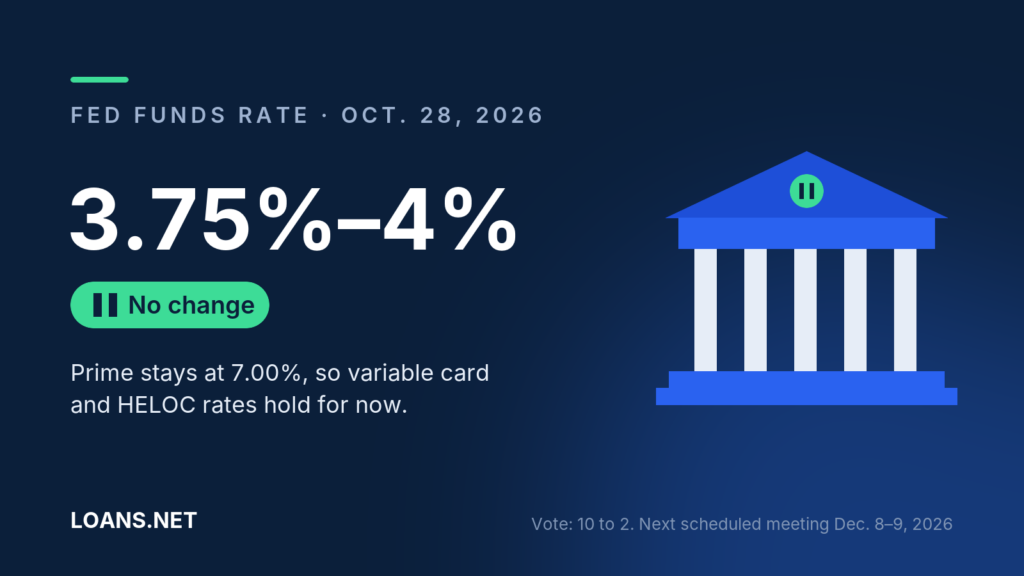
The Fed holds rates steady for now: on October 28, 2026, the Federal Reserve kept the federal funds target range at 3.75% to 4.00%. The vote was 10 to 2, and the two dissenters, Governor Lisa Cook and Cleveland Fed President Beth Hammack, wanted to raise it another quarter point.
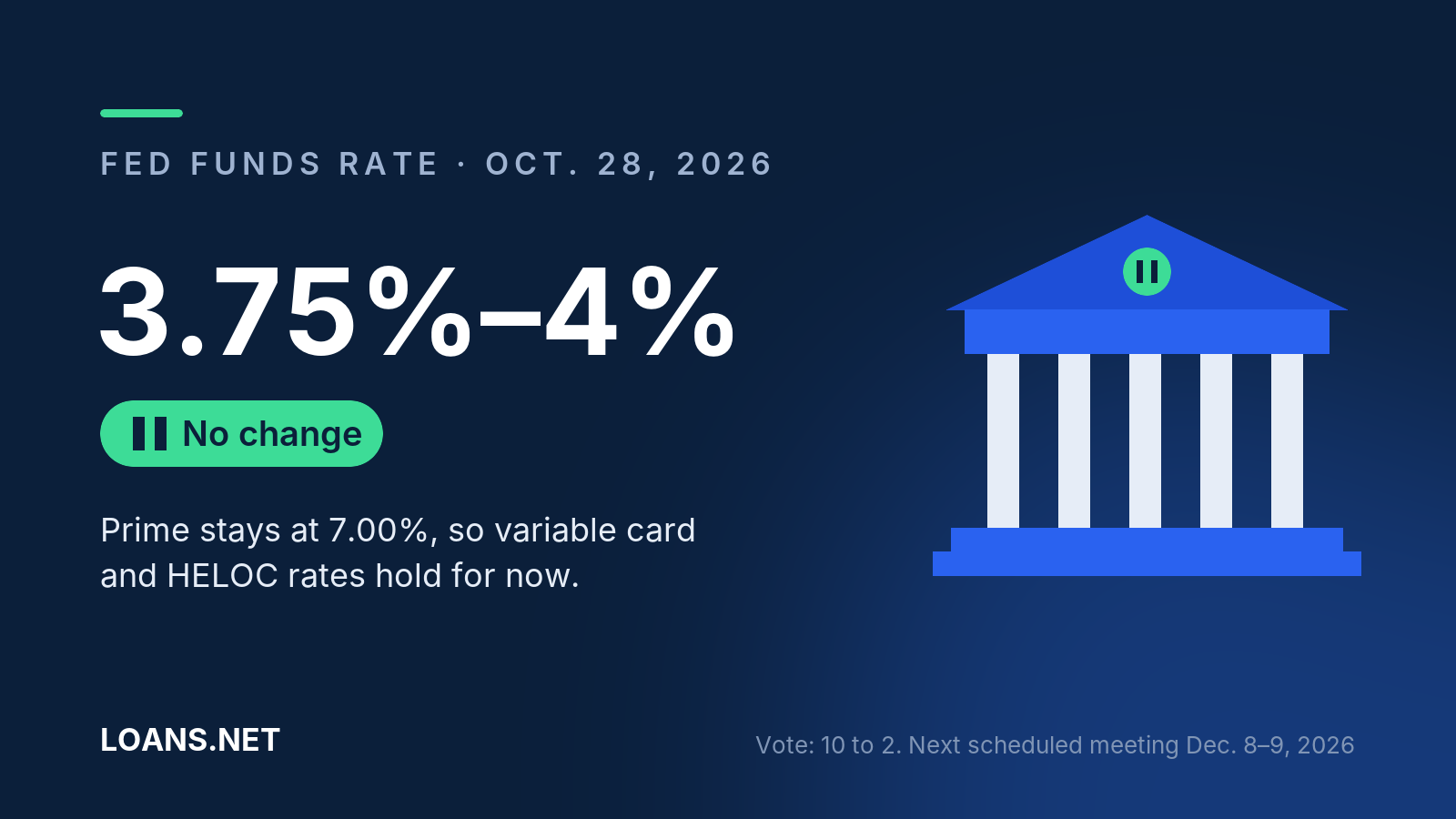
“No change” sounds like relief. What it really means is that September’s higher rates are staying put, and two officials wanted to go higher still.
What does the Fed’s hold change for someone borrowing right now?
In the short run, very little. When the Fed holds rates, nothing you owe gets cheaper, and nothing gets more expensive that day. The prime rate, which most variable credit card and HELOC rates are built on, stays at 7.00%. It has been there since September 17, the day after the Fed’s last increase.
Why the Fed holds rates here, and why it may not be finished
The Fed’s statement says economic activity is “expanding at a strong pace” and that inflation “remains elevated.” It also says the committee wants to gather more information before deciding on further changes. That reads as a wait, not an all-clear.
In the minutes of the September 15 and 16 meeting, most officials said another increase would likely be appropriate by year end. Today two of them voted for one. The next scheduled meeting is December 8 and 9, 2026.
So budget as if your variable rates could rise another quarter point before the year is out. If they don’t, you’re ahead.
What to do, depending on the debt you have
Credit cards with a variable APR
Your APR didn’t move today, but it rose 0.25 points in September and could rise again in December. On a $6,000 balance at an example rate of 24%, another quarter point adds about $15 a year. The quarter point is small. The 24% underneath it is what costs you.
Pay more than the minimum, aim the extra at the highest-rate card first, and if you carry a balance month to month, price a fixed-rate consolidation loan. It only helps when its APR, fees included, is clearly below your card’s rate and you stop adding new charges.
Fixed-rate loans you already have
Most mortgages, auto loans and personal loans have a rate written into the contract, so today’s decision doesn’t touch them. Don’t refinance or pay a fee because of a Fed headline. Refinance only if the new rate and costs beat what you have.
Shopping for a mortgage
Mortgage rates follow longer-term bond yields more than the Fed’s overnight rate, so a hold doesn’t set your rate. Freddie Mac’s 30-year fixed average was 7.32% for the week of October 22, 2026, down from 7.40% the week before. The next reading comes out Thursday, October 29.
Get quotes from at least three lenders on the same day, compare the APR rather than the headline rate, and ask what a rate lock costs and how long it lasts.
HELOCs and adjustable-rate mortgages
Many HELOCs track prime, so your rate stays at its September level for now. Find your margin over prime and your next adjustment date on your statement or loan papers. If a December hike would strain the payment, put extra toward principal now, while you know the rate.
Applying for a personal loan
Lenders price personal loans on your credit profile, income and the loan term, and the Fed’s rate is only one input. A hold doesn’t make you more or less likely to qualify. Compare offers by APR and total cost, and check for an origination fee, because a 5% fee on $10,000 means only $9,500 reaches you.
What the hold does not change
It doesn’t lower any rate you already pay, and it doesn’t change rates on existing federal student loans, which are fixed for the life of the loan.
Rates in these examples are illustrative, not offers. Your actual rate depends on your credit profile and the lender. This is general education, not individual financial advice.
Compare your options
If you’re shopping for a mortgage or a refinance, compare offers side by side before you lock.
Loans.net is a marketplace, not a lender. Checking offers uses a soft credit check. Loans.net is paid by partners.
Sources
- Federal Reserve, FOMC statement, October 28, 2026
- Federal Reserve, FOMC statement, September 16, 2026
- Federal Reserve, Minutes of the FOMC meeting of September 15 and 16, 2026
- Federal Reserve, FOMC meeting calendar
- Federal Reserve, H.15 Selected Interest Rates (bank prime loan rate)
- Freddie Mac, Primary Mortgage Market Survey
- Federal Student Aid, interest rates for federal student loans