Written and reviewed by Yonni Rossa
Americans owed $1.29 trillion on credit cards at the end of September, up $22 billion in three months, according to the New York Fed’s household debt report released on Nov. 10, 2026. The week before, Democrats won both chambers of Congress, and the idea of a 10% cap on card interest rates is back in the headlines. So if you carry a balance, you’re probably asking: should you take a debt consolidation loan now, or hold off and see whether Washington cuts your rate for you?
Short answer: don’t wait. A 10% cap is a proposal, not a law, and the card you carry today keeps charging about 22% every month the proposal stays a proposal. A debt consolidation loan is worth it now if your offered APR, fees included, comes in clearly below your card rate and you stop adding to the cards. If it doesn’t, a nonprofit debt management plan or a 0% balance transfer usually beats both the loan and the waiting.
Is a 10% credit card interest rate cap actually coming?
Not anytime soon, and maybe not at all. The bill most people mean is the 10 Percent Credit Card Interest Rate Cap Act (S.381), which Sen. Bernie Sanders introduced on Feb. 4, 2025. Its last recorded action on Congress.gov is a referral to the Senate Banking Committee. President Trump called for a one-year 10% cap in January 2026, and Sen. Elizabeth Warren, who is in line to chair Senate Banking when the new Congress sits in January, has said she’s willing to work with him on it.
That’s a lot of political goodwill for one number. It’s still not a law. A cap would have to be written, pass the House and the Senate, get signed, and then take effect on whatever date the final text sets. Even its supporters can’t tell you that date today. And critics, including Republican lawmakers who pushed back on the idea in January, argue a hard cap would make card issuers stop lending to riskier borrowers. If your credit is fair or bad, that’s the group they mean.
So I’d treat the cap the way I treat a rumored store sale: nice if it happens, a poor reason to keep paying full price in the meantime.
What does waiting for a rate cap cost you?
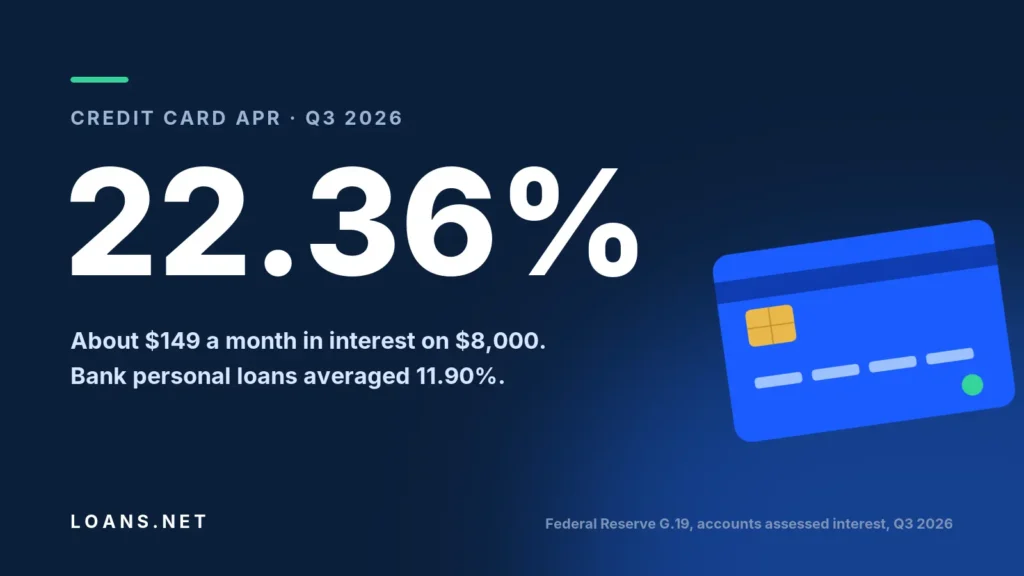
Waiting costs about $149 a month in interest on an $8,000 card balance at 22.36%. That rate isn’t made up. It’s the average commercial-bank card APR on accounts that were charged interest in the third quarter of 2026, from the Federal Reserve’s G.19 consumer credit data (the Fed’s latest G.19 release came out Nov. 6, 2026). Across all card accounts, including people who pay in full, the average was 21.19%.
Monthly interest is simple arithmetic: 22.36% divided by 12 is about 1.86% a month, and 1.86% of $8,000 is $149. Make only interest-sized payments for six months while you wait for Congress and you’ve spent about $937 and still owe $8,000.
That’s the polite version. On the minimum-payment plan most card statements suggest (say 1% of the balance plus that month’s interest), the same $8,000 takes about 23 years to clear and costs roughly $13,800 in interest. Twenty-three years. You could raise a child to legal drinking age in less time than it takes to pay off a mid-sized card balance this way.
How big is the gap between card rates and personal loan rates?
At banks, the gap is about 10 percentage points. The same Fed G.19 data puts the average 24-month personal loan at commercial banks at 11.90% in the third quarter of 2026, against 21.19% to 22.36% on cards. That spread is the whole reason a debt consolidation loan can work: you swap expensive revolving debt for a cheaper installment loan with a fixed payment and an end date.
Before you get excited: 11.90% is an average for loans that banks actually approved, and banks lean toward borrowers with good credit. If your score is in the fair or poor range, your offers may land well above that, sometimes above your card rate. Your offer depends on your credit profile, income, debts and the lender. Nobody, us included, can promise you the bank average.
Debt consolidation loan math: when it saves money and when it doesn’t
A consolidation loan saves money only when its APR, fees included, beats what you’d pay on the card over the same payoff time. Here’s an $8,000 card balance at 22.36%, compared with a few illustrative 36-month loans. The loan rates are examples, not offers. Where there’s an origination fee, I’ve assumed you borrow enough that $8,000 actually lands after the fee, because lenders usually take the fee out of the money you receive.
| Option | Monthly payment | Total interest + fees | Payoff time |
|---|---|---|---|
| Card at 22.36%, minimum payments (1% + interest) | $229 to start, falling | About $13,800 | About 23 years |
| Card at 22.36%, paid off on purpose | $307 | $3,053 | 3 years |
| Loan at 11.90%, no fee | $265 | $1,552 | 3 years |
| Loan at 11.90%, 5% fee | $279 | $2,055 | 3 years |
| Loan at 18%, 5% fee | $304 | $2,960 | 3 years |
| Loan at 25%, 8% fee | $346 | $4,447 | 3 years |
What the table shows:
- The card’s worst enemy is the minimum payment. Pay the card off in three years on purpose and the interest is about $3,053. Drift on minimums and it’s about $13,800.
- A good-credit loan saves real money. At 11.90% with no fee you save about $1,500 versus paying the card off in the same three years, and your payment is $42 a month lower.
- Fees and higher rates eat the savings fast. With a 5% fee, the break-even sits at about 18.5% APR. Above that, the loan costs more than just attacking the card. At 25% with an 8% fee, you’d pay about $1,400 more than the card.
The table also hides a trap. A lower monthly payment can come from a longer term instead of a lower rate. The Consumer Financial Protection Bureau warns that a consolidation loan with a smaller payment can cost more overall if it stretches the repayment period. Compare total cost, not the monthly number. A loan calculator makes this a two-minute job.
Why approval is harder right now if your credit is fair or bad
Banks are getting pickier at the low end of the credit-score range. In the Federal Reserve’s October 2026 Senior Loan Officer Opinion Survey, banks said overall standards for card and consumer loans were basically unchanged in the third quarter. They did make it harder for applicants below their credit-score thresholds to get approved for cards and other consumer loans, and they cut card credit limits. Demand for card loans went up at the same time.
The New York Fed’s Nov. 10 report adds context: 5.0% of all outstanding household debt was in some stage of delinquency, up 0.3 points from the prior quarter, even though new card delinquencies improved slightly. Lenders read those numbers too.
So shop with soft-pull prequalification so you can see offers without a hard inquiry on every application. And if you’re below roughly the fair range, expect fewer offers and higher APRs, and decide in advance that you’ll walk away from any offer that fails the math above. If you’re not sure where you stand, check your credit score first.
Consolidation loan vs. balance transfer vs. debt management plan
The cheapest route depends mostly on your credit and how fast you can pay. The balance transfer is cheapest if you qualify and can finish before the promo ends. The loan is the most predictable. The debt management plan is often the best fit when your credit is too bruised for either.
| Option | Typical cost | Credit needed | Payoff time | Main risk |
|---|---|---|---|---|
| Debt consolidation loan | Fixed APR, may include an origination fee | Fair to excellent; best rates go to good credit | Usually 2 to 5 years, fixed | Running the cards back up after paying them off |
| 0% balance transfer card | Transfer fee, then the card’s regular APR after the promo | Usually good to excellent | Only as long as the promo period | Rate jumps when the promo ends or after a payment 60+ days late |
| Nonprofit debt management plan | Small monthly fee in many plans; creditors may lower your rates | No minimum score | Often 3 to 5 years | Accounts are usually closed; missing plan payments can end the deal |
| Wait for a rate cap | Your current card APR, every month | None | Unknown | The cap may never pass, or may come with fewer approvals |
A note on balance transfers from the CFPB: new purchases on a card holding a transferred balance often lose their grace period, so you can pay interest on groceries while the transfer sits at 0%. Use the transfer card for the transfer and nothing else.
And a note on home equity: the New York Fed reported HELOC balances rose $23 billion in the third quarter, the biggest jump since 2005. A HELOC can carry a lower rate than a personal loan, but it turns card debt into debt secured by your house. Read our comparison of secured vs. unsecured loans before you go that way.
Is a debt consolidation loan worth it for you?
It’s worth it when four things are true. Run through them before you apply anywhere.
- The APR beats your card’s rate by a real margin. Use the APR, not the interest rate, because the APR includes the origination fee. If the APR isn’t at least a few points below your card’s, skip it.
- The term is no longer than you’d need to pay off the card on purpose. A 60-month loan with a low payment can quietly cost more than a 36-month card payoff.
- The payment fits your budget today, not the budget you’ll have after a raise you haven’t gotten yet.
- You have a plan for the empty cards. Consolidation followed by new card balances is how $8,000 of debt turns into $16,000.
Who it fits best: borrowers with good credit, steady income and $3,000 or more of card debt they can clear within three to five years. Who should think twice: anyone whose offers come back near or above their card rate, anyone already behind on payments (call a nonprofit credit counselor first), and anyone tempted by a payday loan or cash advance to make card payments. Borrowing at triple-digit APRs to pay a 22% card is going backwards.
And sometimes the right move is not borrowing at all. If your balance is small enough to clear in 12 months with a tighter budget, keep your card, stop using it, and throw every spare dollar at it. You pay no fee and no lender gets involved.
Compare your options
Card debt at 22% while Congress debates a cap? See whether a consolidation loan actually beats your card rate.
Loans.net is a marketplace, not a lender. Checking offers uses a soft credit check. Loans.net is paid by partners.
What to do this week
Ten minutes of homework, in this order:
- Find your card’s actual APR on your latest statement. Not the one you remember, the one printed there.
- Write down your total balance and what you could pay each month without missing rent.
- Run that balance through a loan calculator at your card’s rate and at a 36-month loan rate to see the gap.
- Prequalify with a soft credit check and compare APRs, fees and total cost side by side.
- Take the loan only if it passes the four-point test above. Otherwise, call a nonprofit credit counselor about a debt management plan.
Then set a reminder for January, when the new Congress sits, and check what actually happens to the cap bill. If it passes, great, you’ll be paying it off at a lower rate. If it doesn’t, you won’t have lost a thing by starting now.
FAQ
Is the 10% credit card interest rate cap a law?
No. As of Nov. 11, 2026, the 10 Percent Credit Card Interest Rate Cap Act (S.381) has been introduced and referred to the Senate Banking Committee but not passed. Any cap would need to pass both chambers and be signed, and the effective date would depend on the final bill.
Will a debt consolidation loan hurt my credit score?
Usually only a little at first, and it can help over time. Prequalifying with a soft check doesn’t affect your score; a lender’s formal application typically adds a hard inquiry. Moving card balances to an installment loan lowers your card utilization, which tends to help, as long as you don’t run the cards back up. More on that in our guide to improving your credit.
Can I get a debt consolidation loan with bad credit?
Sometimes, but expect fewer offers and higher APRs, and banks tightened approvals below their score cutoffs in the Fed’s October 2026 survey. Run every offer through the break-even math. If it doesn’t beat your card, a nonprofit debt management plan is often the better fit. See our page on bad credit loans for what to watch for.
Should I close my credit cards after consolidating?
Not necessarily. Closing old cards can raise your utilization and shorten your credit history. Many people keep them open with a zero balance and the card out of their wallet. If you know you’ll use them, closing one or two may be the safer trade.
Sources
- Federal Reserve Bank of New York, Household Debt and Credit Report, Q3 2026 (Nov. 10, 2026)
- Federal Reserve Bank of New York press release, Nov. 10, 2026
- Federal Reserve Board, G.19 Consumer Credit (released Nov. 6, 2026)
- Federal Reserve Board, October 2026 Senior Loan Officer Opinion Survey
- Congress.gov, S.381, 10 Percent Credit Card Interest Rate Cap Act
- U.S. Senate Banking Committee, Sen. Warren statement on a one-year cap on credit card interest rates (Jan. 9, 2026)
- Consumer Financial Protection Bureau, What do I need to know about consolidating my credit card debt?
Worked examples are illustrations, not offers. Your rate and terms depend on your credit profile and the lender. This article is general education, not individual financial advice.