Written and reviewed by Yonni Rossa
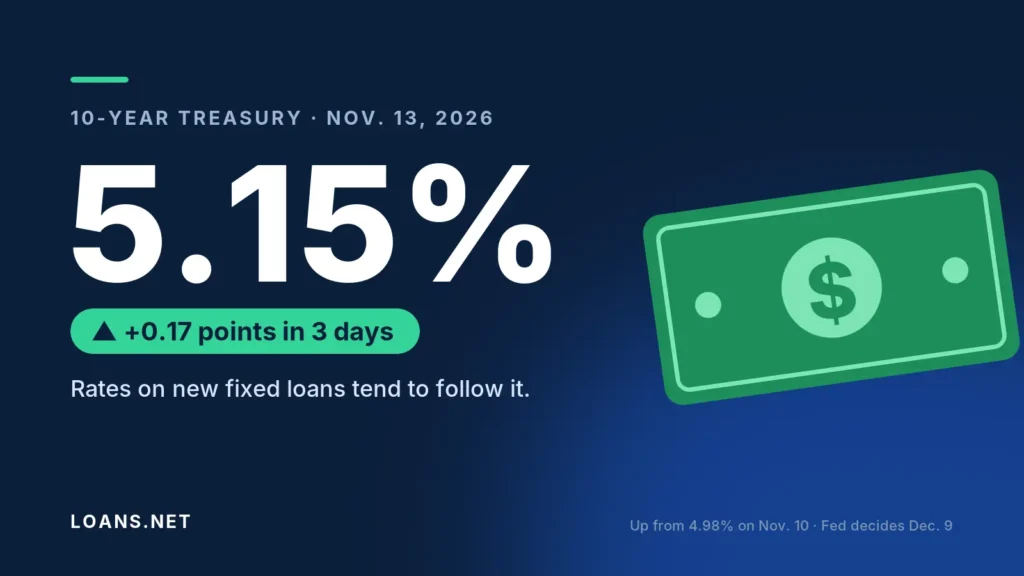
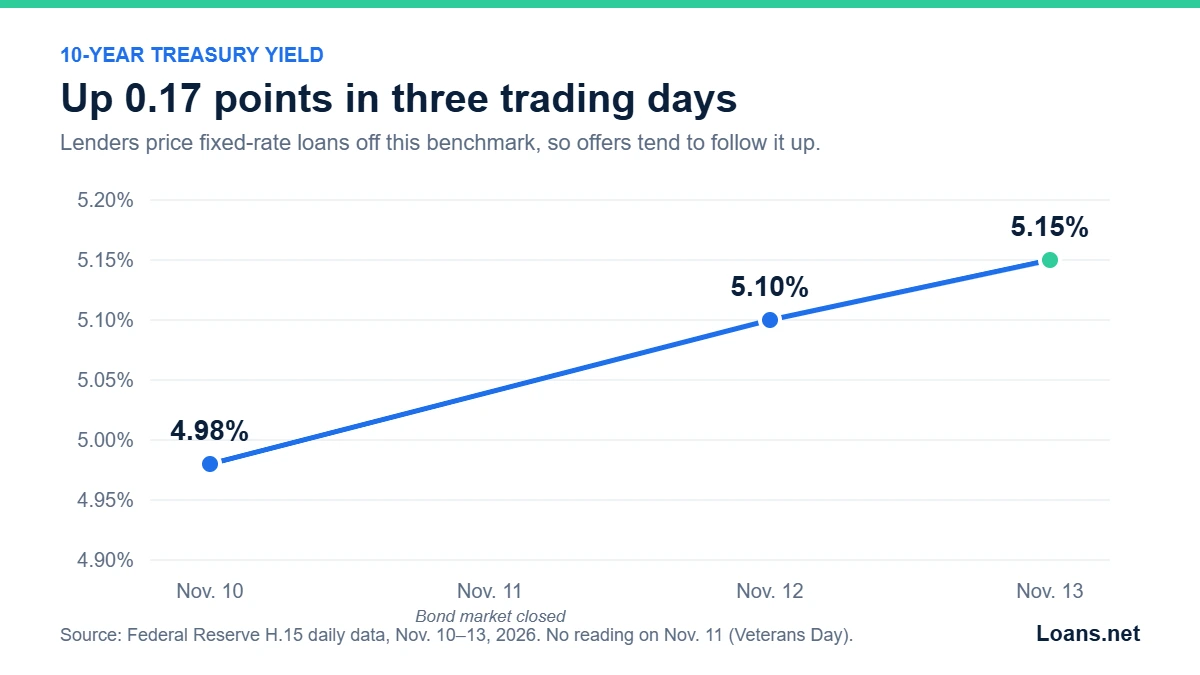
The Fed’s next rate decision isn’t until Dec. 9, but the loan market isn’t waiting. October’s inflation report came out hot on Nov. 10, 2026, and by Nov. 13 the 10-year Treasury yield was at 5.15%, up from 4.98% three days earlier, according to the Federal Reserve’s H.15 data. Three Fed officials have argued for another hike since late October. So if you need to borrow, the obvious question is whether to get a loan before rates go up.
Short answer: if you already need the money in the next month or two, compare fixed-rate offers now, because the benchmarks lenders price from have already moved up. But don’t borrow just to beat the Fed. On a typical personal loan, a quarter-point hike costs about $1 a month. Your credit profile and how many offers you compare matter far more than the Fed’s calendar.
What changed this week, and why rates are heading up
Rates are heading up because inflation came in hot and bond yields jumped within days. The Bureau of Labor Statistics reported on Nov. 10 that consumer prices rose 0.4% in October after 0.6% in September. Core prices, which leave out food and energy, rose 0.3% for the third month in a row. BLS couldn’t publish a 12-month change for many indexes this time because October 2025 prices were never collected during the government shutdown, so any “annual inflation” headline you see for October is an estimate, not a BLS number.
The Fed had already started raising rates. It lifted its target range by a quarter point on Sept. 16, then held at 3.75% to 4.00% on Oct. 28. That second decision was a 10-2 vote, and both dissenters, Lisa Cook and Beth Hammack, wanted another quarter-point hike right then. On Nov. 10, Governor Christopher Waller argued in a speech in London that a half-point move should be considered in December if core inflation kept running near 0.3% a month. It did.
Bond traders didn’t wait for December. The H.15 table shows the 10-year Treasury at 5.10% on Nov. 12 and 5.15% on Nov. 13. That matters to you more than the Fed’s announcement will, for reasons the next section covers.
What to do with this: look at your own debts and figure out which ones are fixed and which are variable. That’s the whole decision.
What a Fed rate hike actually changes for your loans
A Fed hike changes variable-rate debt fast and leaves your existing fixed-rate loans alone. If you already have a fixed-rate personal loan, auto loan or mortgage, your rate and payment stay the same no matter what the Fed does on Dec. 9. Credit cards and HELOCs are different. Their rates are usually tied to the prime rate, which was 7.00% on every day of the week ending Nov. 13, per H.15. Banks have set prime at 3 points above the top of the Fed’s range for years (4.00% plus 3), so a quarter-point hike would most likely take prime to 7.25%, and your card or HELOC rate typically follows within a billing cycle or two. New fixed-rate loans sit in the middle: lenders price them off their own funding costs and Treasury yields, which is why they can rise before the Fed moves at all.
| Type of debt | What a December hike does | How fast | What to do |
|---|---|---|---|
| Existing fixed personal, auto or mortgage loan | Nothing. Your rate is locked. | Never | Keep paying. Ignore the headlines. |
| Credit card balance | APR rises with prime | Usually within one or two billing cycles | Pay it down or move it to a lower fixed rate |
| HELOC | Rate rises with prime | Usually the next billing cycle | Check your index and margin; plan for a higher payment |
| New personal or auto loan | Priced off lender funding costs, which follow yields | Already moving | Compare offers now if you need to borrow anyway |
| New mortgage | Follows the 10-year Treasury, not the Fed directly | Already moving | Lock once you have a contract and a rate you can live with |
Next step: pull up your last card and HELOC statements and find the line that says “variable.” That’s your exposure.
How much a quarter-point hike costs you: the math
A quarter-point increase is small on short loans and large on mortgages. Here’s what 0.25 and 0.50 points do to four common debts. The rates are examples, not offers; what you’re quoted depends on your credit profile and the lender.
| Loan (example) | Before | Plus 0.25 point | Plus 0.50 point |
|---|---|---|---|
| $10,000 personal loan, 36 months | 13.00%: $336.94/mo, $2,130 interest | 13.25%: $338.14/mo, $2,173 interest | 13.50%: $339.35/mo, $2,217 interest |
| $25,000 auto loan, 60 months | 7.50%: $500.95/mo, $5,057 interest | 7.75%: $503.92/mo, $5,235 interest | 8.00%: $506.91/mo, $5,415 interest |
| $350,000 mortgage, 30 years | 7.11%: $2,354/mo | 7.36%: $2,414/mo | 7.61%: $2,474/mo |
| $6,000 card balance | 22% APR | About $15 more interest a year | About $30 more interest a year |
On the $10,000 personal loan, a quarter point adds $1.20 a month and about $43 over three years. That’s not worth rushing for.
Now compare that with the gap between credit tiers. The same $10,000 over 36 months at 20% costs $371.64 a month and $3,379 in interest. At 28% it’s $413.64 a month and $4,891 in interest. The difference between a 13% offer and a 28% offer is about $2,760, roughly 64 times what a quarter-point Fed hike costs you on that loan.
The mortgage is where timing really counts. A quarter point on $350,000 adds about $59 a month, which is about $21,350 over 30 years if you never refinance.
What to do with this: if you’re borrowing under $25,000 on a short term, put your energy into your credit and into comparing lenders, not into beating Dec. 9. If you’re buying a house, the rate on the day you lock matters a lot.
Should you get a loan before rates go up?
Borrow now only if you’d borrow anyway; never take a loan just because rates might rise. Here’s how that plays out for different people.
- You need the money for something that can’t wait (a car repair to get to work, a medical bill, a move). Compare fixed-rate offers this week. Yields are rising, so waiting is more likely to cost you a little than save you anything.
- You’re carrying card debt at 20% or more and have fair-to-good credit. A fixed-rate personal loan that comes in well below your card APR, fees included, takes that balance out of the path of every future hike. Our debt consolidation guide walks through the break-even test.
- Your credit score is below about 620 or recently took a hit. Rushing usually means accepting a high rate. A few months of on-time payments and lower card balances can move your offers more than the Fed can. Start with how your credit score is calculated.
- The purchase is optional (a vacation, an upgrade, a “rates will never be this low again” impulse). Wait or save. A quarter point won’t make an unneeded loan a good idea.
- You have a home purchase under contract. Talk to your lender about a rate lock now. That decision has real money in it, and the next section covers it.
Mortgages: lock now or wait?
If you have a signed purchase contract and a rate you can afford, locking is the safer move right now. Freddie Mac’s survey put the 30-year fixed at 7.11% on Nov. 12, 2026, down from 7.18% a week earlier and the lowest in seven weeks. That was the fourth straight weekly drop. A year earlier the rate was 6.24%.
The catch is timing. Freddie Mac’s survey reflects applications taken during the week, and most of that week came before the 10-year yield climbed past 5%. Mortgage rates tend to follow the 10-year, so the next readings are more likely to move up than down. No one can promise that, but the direction of the benchmark is clear.
What to do:
- Ask your lender how long a lock lasts, what it costs, and whether there’s a float-down option if rates fall before closing.
- Run your payment at your quoted rate and at a quarter point higher in the mortgage calculator. If the higher payment breaks your budget, lock.
- If you’re thinking about refinancing, check the numbers first. With rates above 7%, a refinance only pays off if your current rate is higher than today’s and you’ll stay in the home long enough to recover the closing costs.
Credit cards and HELOCs: the debt a hike hits first
Variable-rate debt is where a December hike shows up first, so that’s where to act. The New York Fed reported on Nov. 10 that Americans’ credit card balances rose $22 billion in the third quarter to about $1.29 trillion, and total household debt reached $19.1 trillion. It also found 5.0% of outstanding debt was in some stage of delinquency, up 0.3 percentage points from the prior quarter.
On a card, a quarter point is small next to the rate you already pay. The bigger issue is that the balance is variable at all. Each hike stacks on the last one, and nothing caps how many there are.
For a HELOC, look up your index (usually prime) and your margin. A $50,000 balance would cost about $125 more a year in interest per quarter-point increase, roughly $10 a month. If you’re making interest-only payments, that change shows up right away. Our home equity page explains how the draw and repayment periods work.
What to do this week: list every variable balance and its current rate. Pay the highest-rate balance down first, or move it to a fixed rate if you can get one that’s clearly lower.
How to decide in four steps this week
You can make this call in about an hour with your own numbers.
- Write down the purpose and the amount. If you can’t name what the loan is for and why it can’t wait, stop here.
- Set your payment ceiling. Pick the shortest term whose payment you could cover in a bad month, and check it in the loan calculator.
- Check prequalified offers with a soft credit check. A soft pull doesn’t affect your score. A hard inquiry happens only when you go ahead with a lender’s formal application.
- Compare total cost, not the monthly payment. Add the origination fee to the interest. If no offer beats your current rate or fits your ceiling, don’t take one.
Compare your options
If you need to borrow anyway, see what fixed rates lenders offer you before the Fed decides on Dec. 9.
Loans.net is a marketplace, not a lender. Lenders may check your credit. Loans.net is paid by partners.
When not borrowing is the better choice
Waiting, or not borrowing, is better when the loan is optional, when your best offer is above about 30%, or when the payment only fits in a good month. It’s also better if you’re thinking about a payday loan to cover another loan’s payment. That usually adds fees on top of the debt you already have, and a nonprofit credit counselor is a better first call.
A hike also doesn’t change the basic math on an emergency fund. If you can cover the expense from savings without dropping below a month of essentials, that’s usually cheaper than any loan. Our personal loans guide covers the cases where borrowing makes more sense.
FAQ
Will the Fed raise rates in December 2026?
No decision has been made; the Fed announces it on Dec. 9 at 2 p.m. Eastern. Two officials voted for a hike in October, and Governor Waller has said a half-point move should be considered. Treat a hike as likely but not certain.
Will personal loan rates go up after a Fed hike?
Usually, yes, for new loans, though often by less than the Fed’s move and with a lag. Your existing fixed-rate personal loan won’t change at all. What you’re quoted depends far more on your credit score, income and debt load than on the Fed.
Does a Fed rate hike affect my existing car loan or mortgage?
No, not if it’s a fixed-rate loan. Fixed rates stay the same for the life of the loan. Adjustable-rate mortgages change only at their scheduled adjustment dates, based on the index named in your loan documents.
How fast does a Fed hike hit my credit card APR?
Usually within one or two billing cycles. Most card APRs are set at prime plus a margin, and prime typically moves the day after the Fed announces a change. Your card agreement says which index it uses.
Does checking loan rates hurt my credit?
Checking prequalified offers uses a soft credit check, which doesn’t affect your score. A hard inquiry happens only when you submit a formal application with a lender, and it typically costs a few points for a limited time.
Sources
- U.S. Bureau of Labor Statistics, Consumer Price Index, October 2026 (released Nov. 10, 2026)
- Federal Reserve Board, FOMC statement, Oct. 28, 2026
- Federal Reserve Board, FOMC statement, Sept. 16, 2026
- Federal Reserve Board, Governor Waller speech on the economic outlook, Nov. 10, 2026
- Federal Reserve Board, H.15 Selected Interest Rates (Nov. 16, 2026 release)
- Federal Reserve Board, FOMC meeting calendar
- Freddie Mac, Primary Mortgage Market Survey, Nov. 12, 2026
- Federal Reserve Bank of New York, Household Debt and Credit Report, Q3 2026 (Nov. 10, 2026)
Worked examples are illustrations, not offers. Your rate and terms depend on your credit profile and the lender. This article is general education, not individual financial advice.