Written and reviewed by Yonni Rossa
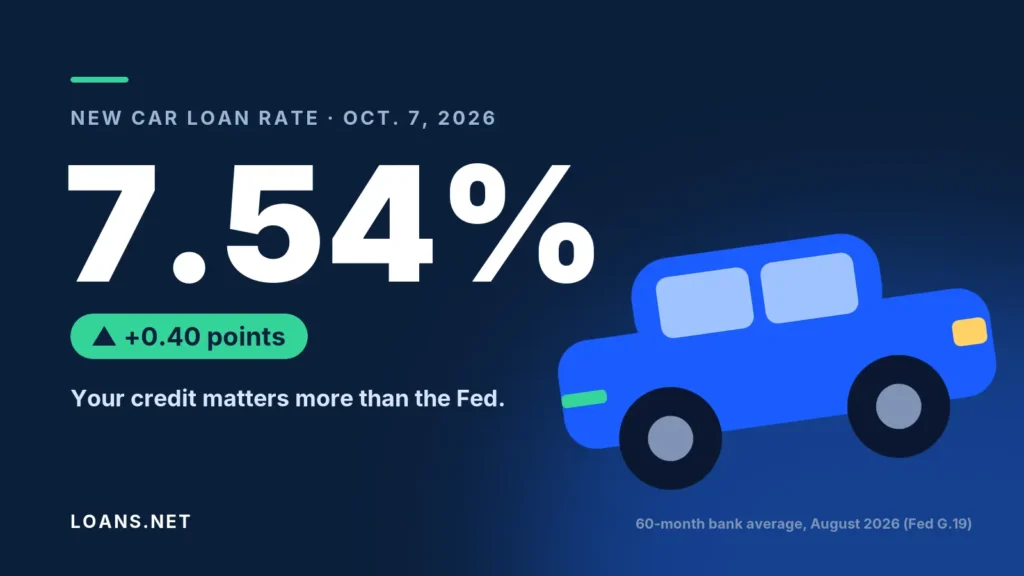
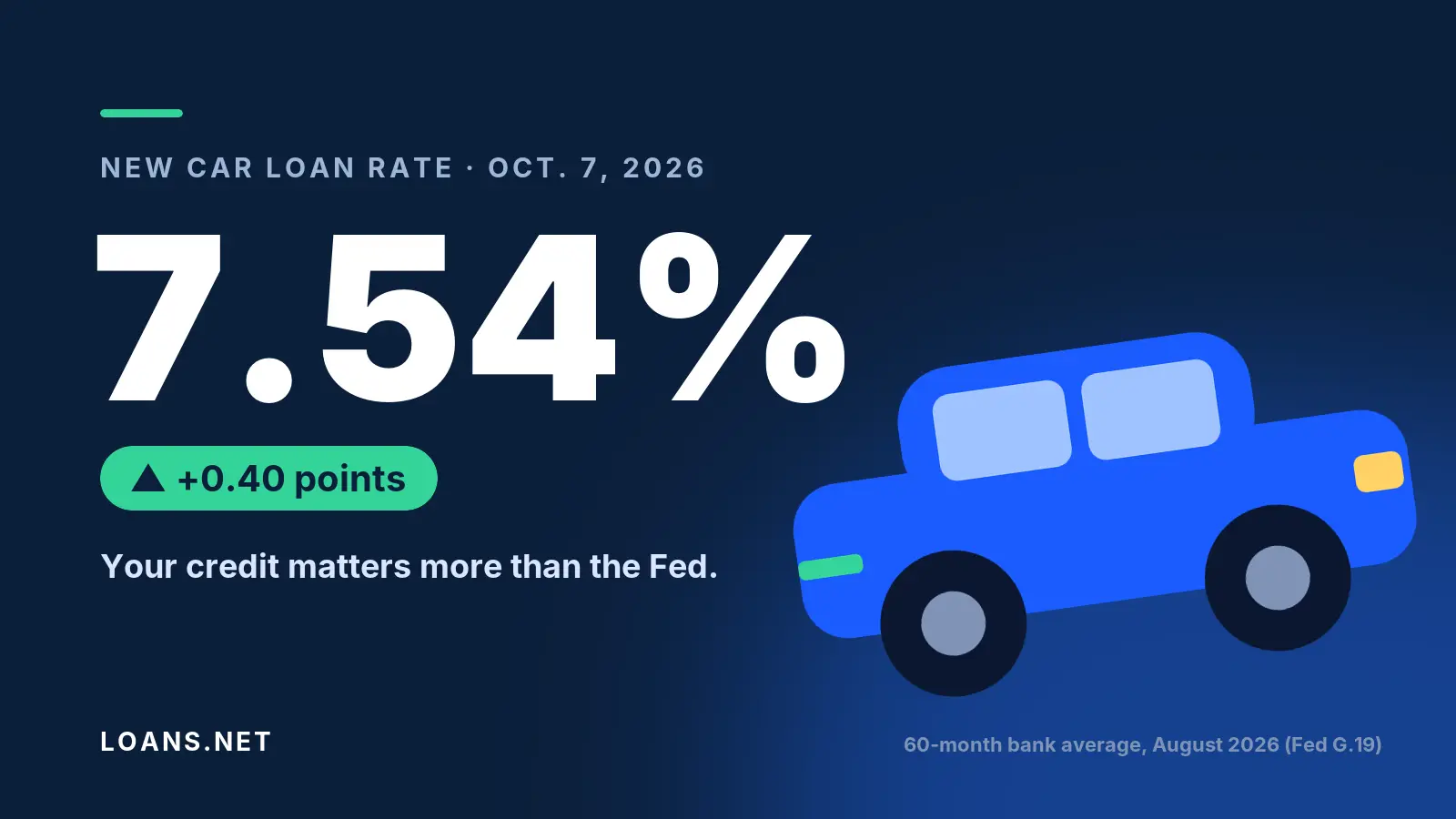
On Oct. 7, 2026, the Federal Reserve reported that 60-month new car loans at commercial banks averaged 7.54% in August, up from 7.14% in May. The same day, minutes from the Fed’s September meeting showed most officials expect to raise rates again. So if you need a car, should you buy a car now or wait for rates to come back down?
Short answer: don’t wait for the Fed. A 0.40-point rate rise adds about $7 a month to a $35,000, five-year loan. Waiting only pays if the time gets you a better credit score, a bigger down payment or a cheaper car, and your current car can hold out while you do it.
The rest of this post runs the math, because the math is where this decision gets made.
What changed for car loan rates this month
Car loan rates went up, and the Fed has said it isn’t done. Three releases from the past week tell the story:
- Bank car loan rates rose 0.40 points. The Fed’s G.19 consumer credit report, released Oct. 7, puts the average 60-month new car loan rate at commercial banks at 7.54% for August, up from 7.14% in the prior quarter. The Fed collects these in the middle month of each quarter, so this is the first reading since May.
- The Fed raised its target and expects to keep going. On Sept. 16 the Fed raised the federal funds target range by a quarter point to 3.75% to 4.00%, on a 12-0 vote. The minutes of that meeting, released Oct. 7, say most participants judged that another increase would be appropriate.
- A Fed governor put a number on it. In an Oct. 8 speech, Governor Christopher Waller said 16 of the 18 officials who submitted projections in September expect at least one more hike at the two meetings left this year. He added that the hikes don’t have to come at back-to-back meetings. The next decision is due Oct. 28.
So the direction for the rest of 2026 is up, not down. Anyone holding off on a car purchase because “rates are about to drop” is waiting for something the Fed itself says isn’t coming this year.
Should you buy a car now or wait? The math on the rate move
On a $35,000 loan over 60 months, the jump from 7.14% to 7.54% costs about $7 a month and roughly $400 over the life of the loan. That’s real money. It is also about the price of one oil change a year.
Here’s the arithmetic. These use the Fed’s average bank rates; your own rate depends on your credit, the lender and the car.
- $35,000 at 7.14% for 60 months: about $695 a month, $6,721 in total interest.
- $35,000 at 7.54% for 60 months: about $702 a month, $7,120 in total interest.
- $35,000 at 7.79% (if another quarter-point hike passed straight through to car loans, which isn’t guaranteed): about $706 a month, $7,370 in total interest.
Another Fed hike, if it shows up in car loan pricing at all, would add about $4 a month to this loan. If you’re agonizing over whether to sign before or after Oct. 28, you can let that one go. A single quarter point is not what makes a car loan expensive.
It also matters that most car loans carry a fixed rate. Once you sign, later Fed moves don’t touch your payment. That cuts both ways: buying now locks in today’s rate, and if rates fall in a year or two, you can try to refinance then.
The numbers that cost more than the Fed
Your credit score, your loan term and the size of the loan move your cost far more than a Fed hike does. The table below uses the same $35,000 loan. The 7.54% row is the Fed’s August bank average; the 11% and 15% rows are illustrative rates of the kind fair and bad credit borrowers often see, not quotes.
| $35,000 loan | Monthly payment | Total interest |
|---|---|---|
| 7.54%, 60 months (Fed bank average) | $702 | $7,120 |
| 7.54%, 72 months | $606 | $8,620 |
| 7.54%, 84 months | $538 | $10,153 |
| 11%, 60 months (illustrative, fair credit) | $761 | $10,659 |
| 15%, 60 months (illustrative, bad credit) | $833 | $14,959 |
| 15%, 72 months (illustrative, bad credit) | $740 | $18,285 |
Look at the gap between the top row and the 15% row: about $7,840 in extra interest. That’s nearly 20 times what the Fed’s 0.40-point move cost. Stretching the same loan from 60 to 84 months drops the payment by $164 and adds about $3,033 in interest. The dealer will happily show you the $538 payment. They are less likely to show you the $10,153.
If you want to try your own numbers, the Loans.net loan calculator runs the same math.
Worked example: buy today or wait six months?
Waiting six months and saving $500 a month toward the down payment beats buying today by about $380 in interest, but only if the car you’re driving now survives without a big repair. Here are two versions of the same person, shopping for the same $35,000 car.
Buy-Now Bailey signs this month: $35,000 at 7.54% for 60 months. Payment: about $702. Interest: about $7,120.
Wait-and-See Wren keeps the old car six more months and puts $500 a month aside, which adds $3,000 to the down payment. Wren then borrows $32,000. To be conservative, assume rates did go up another quarter point to 7.79%. Payment: about $646. Interest: about $6,738.
Wren pays about $56 a month less for five years and about $382 less in interest, even after a rate hike. The $3,000 Wren saved is still Wren’s money; it just went into the car instead of a lender’s pocket.
Now the catch. Wren’s whole advantage is about $382 in interest. One transmission problem, one set of tires plus brakes, or one tow and a week of ride-shares can eat that and then some. Car prices can also move in six months, in either direction. So waiting wins on paper only when the current car is reliable and the waiting period actually produces savings. Waiting while spending the $500 on something else gets you a rate hike and nothing in return.
Buy now vs. wait: side by side
| Buy now | Wait 3 to 12 months | |
|---|---|---|
| Rate risk | Locks today’s fixed rate | Fed signals more hikes in 2026 |
| Effect of one quarter-point hike on $35,000, 60 months | None after you sign | About $4 a month, $250 total |
| Down payment | Whatever you have today | Can grow if you save each month |
| Credit score | Priced on today’s score | Can improve if you pay down cards and pay on time |
| Old car risk | Gone | Repairs can wipe out the savings |
| Best for | Car is failing; credit and savings won’t change soon | Car runs fine; you have a concrete plan to save or fix credit |
When waiting is the smarter move
Waiting makes sense when the delay buys you a lower rate through your own credit, not through the Fed. That usually means:
- Your score is near a cutoff. If you’re in the fair or bad credit range and a few months of on-time payments and lower card balances could move you up a tier, the difference can be thousands of dollars, as the table shows. Our guide to improving your credit lays out what tends to move a score fastest. Paying down credit card balances usually helps sooner than waiting for old marks to age.
- You have a recent late payment or collection. Lenders weigh recent problems more heavily. A clean stretch of several months can change how your application looks.
- Your down payment is close to zero. Borrowing the full price plus taxes and fees can leave you owing more than the car is worth for years. Even a few thousand dollars down shrinks the loan and the interest.
- Your current car runs fine. The cheapest car payment is no car payment. Every month you drive a paid-off car is a month you keep that $700.
And sometimes the right answer is to skip the loan entirely or buy less car. A $20,000 used car at the same 7.54% for 60 months runs about $401 a month and $4,068 in interest. That’s $301 a month less than the $35,000 version. Nobody gets a trophy for the bigger payment.
When buying now makes sense
Buying now is reasonable when you need the car and nothing about your situation will improve by spring:
- Your current car is unsafe or keeps needing repairs, and you need it for work.
- Your credit is already good, so waiting won’t get you a meaningfully better tier.
- You have your down payment saved and the monthly payment fits your budget on a 60-month term or shorter.
If that’s you, the Fed is a reason to stop dithering, not a reason to wait. With most officials expecting another hike, rates are more likely to drift up than down between now and year end. What you can control is where you get the loan.
Shop for the loan before you shop for the car
The CFPB recommends getting preapproved by a bank, credit union or other lender before you go to the dealer, so you walk in with a rate, a term and a maximum loan amount to compare against the dealer’s offer. That matters because dealer-arranged financing can include a markup: the CFPB has explained that dealers can charge you more than the “buy rate” the lender approved, and keep part of the difference. The CFPB also notes that dealer financing is negotiable.
A simple order of operations:
- Check your credit first. Know your score and fix any errors on your reports before you apply. Our credit score guide explains what lenders look at.
- Set a budget by total cost, not monthly payment. Pick the term first (60 months or shorter if you can), then work out the price you can afford.
- Get several offers in a short window. Compare the APR, the term and any fees side by side. Our car loans page covers how auto financing works, including options for bad credit.
- Let the dealer try to beat your best offer. If they can, great. If they can’t, you already have financing lined up.
- Negotiate the car price separately from the financing. A low payment can hide a high price or a long term.
For people with bad credit: be wary of any deal that only works at 72 or 84 months. At 15% over 72 months, the illustrative $35,000 loan above costs $18,285 in interest. That’s more than half the price of the car again. A cheaper car or a few months of credit repair will almost always beat that.
Compare your options
Car loan rates are rising. See what lenders may offer you before you sit down at the dealer’s desk.
Loans.net is a marketplace, not a lender. Checking offers uses a soft credit check. Loans.net is paid by partners.
FAQ
Will car loan rates go down in 2026?
It looks unlikely. The Fed raised rates on Sept. 16, 2026, and in an Oct. 8 speech Governor Waller said 16 of 18 Fed officials who submitted projections expect at least one more hike this year. Car loan rates don’t track the Fed one for one, but the pressure is upward.
Does a Fed rate hike change my existing car loan?
Not if your loan has a fixed rate, which most car loans do. Your rate and payment stay the same for the life of the loan. Check your contract if you aren’t sure.
What is the average car loan rate right now?
The Fed’s G.19 report, released Oct. 7, 2026, put the average 60-month new car loan rate at commercial banks at 7.54% for August 2026. That’s an average of banks’ most common rates; borrowers with fair or bad credit usually pay more.
Is it better to get a car loan from the dealer or a bank?
Get a preapproval from a bank, credit union or other lender first, then let the dealer try to beat it. The CFPB says dealer financing can include a markup over the lender’s rate and is negotiable.
Can I refinance my car loan later if rates drop?
Often, yes, if your credit is in good shape and the car still has enough value relative to the loan. Watch for fees and don’t extend the term so far that you pay more interest overall.
Sources
- Federal Reserve, G.19 Consumer Credit, August 2026 (released Oct. 7, 2026)
- Federal Reserve, FOMC statement, Sept. 16, 2026
- Federal Reserve, Minutes of the FOMC, Sept. 15-16, 2026 (released Oct. 7, 2026)
- Federal Reserve, Governor Christopher Waller, speech on the economic outlook, Oct. 8, 2026
- CFPB, Am I required to get my auto loan through a dealership?
- CFPB, Auto loan guide
- CFPB, bulletin on auto dealer markup
Payment examples are illustrative and rounded. Your actual rate and terms depend on your credit profile, the vehicle and the lender. Loans.net is a loan marketplace, not a lender, and does not make credit decisions.