Written and reviewed by Yonni Rossa
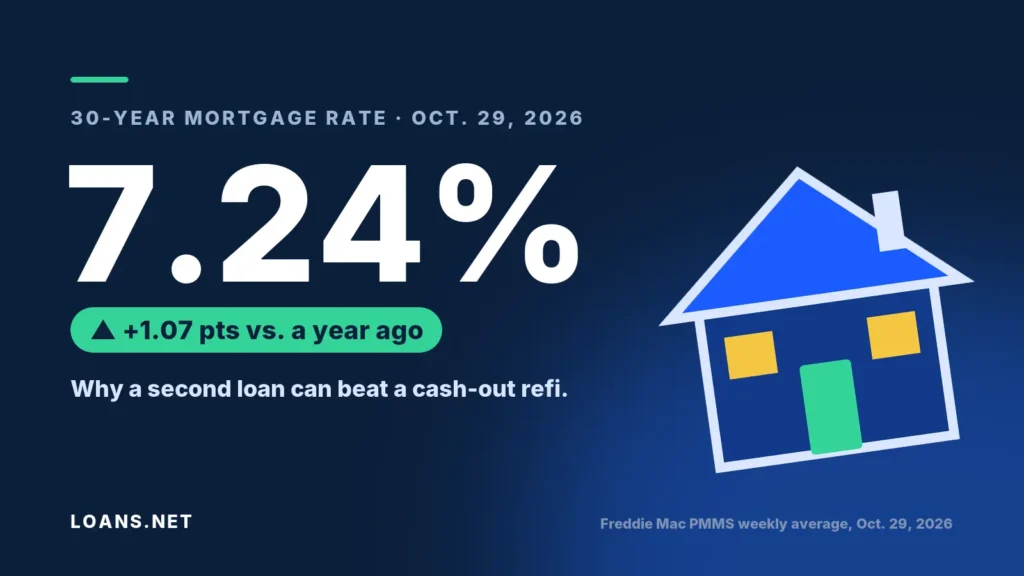
Americans have picked up a strange new habit: guarding an old mortgage rate the way earlier generations guarded the good china. On Oct. 29, 2026, Freddie Mac’s weekly survey put the average 30-year fixed mortgage at 7.24%, down from 7.32% the week before but up from 6.17% a year earlier (Freddie Mac PMMS). So if you’re sitting on a 3% or 4% mortgage and need $30,000 for a roof, a kitchen or a pile of bills, the question is HELOC vs personal loan (or a home equity loan), and which one costs you least.
Short answer: if you have the home equity and steady income, a home equity loan or HELOC will usually cost less in interest than a personal loan, and almost anything beats a cash-out refinance at today’s rates. A personal loan is the better fit for smaller amounts, for borrowers who can pay it off within a few years, and for anyone who doesn’t want their house on the line. The arithmetic below shows where the lines fall.
Why a cash-out refinance is the expensive default right now
A cash-out refinance swaps your whole low-rate mortgage for a new one at today’s rate, so you repay the old balance at the higher rate too. That is a lot of money to pay for $30,000.
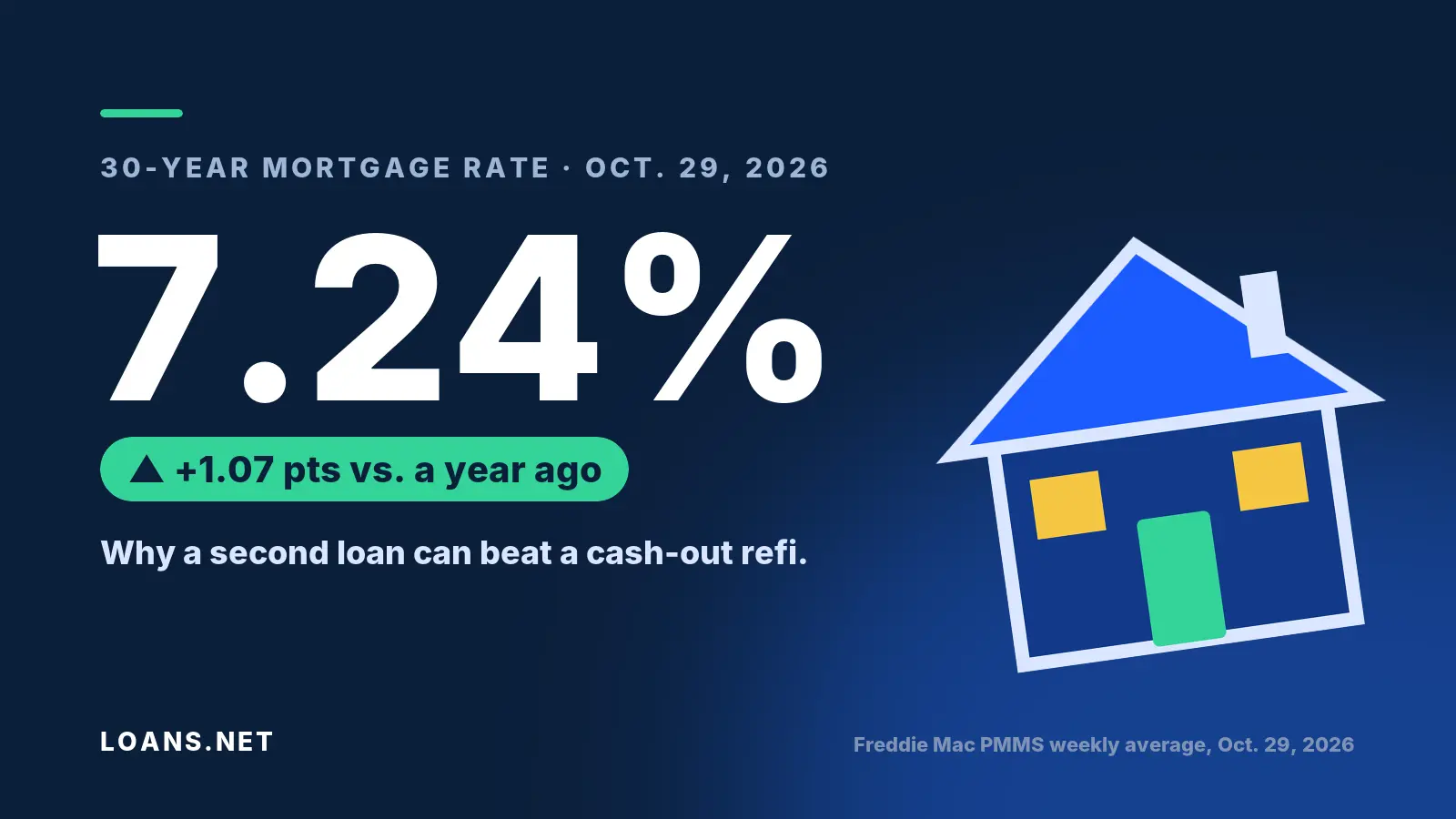
Take an illustrative homeowner who borrowed $300,000 at 3.25% five years ago. The principal and interest payment is about $1,306 a month, and about $267,900 is still owed. Refinance that into a new 30-year loan for $297,900 (the old balance plus $30,000 in cash) at 7.24%, the Oct. 29 survey average, and the payment jumps to about $2,030. That’s roughly $725 more every month, for 30 years, to get your hands on $30,000.
Now leave the first mortgage alone and add a 10-year, $30,000 home equity loan at an illustrative 8.5%. The new payment is about $372, so the total comes to about $1,678 a month. Same cash, about $350 a month less than the refinance, and the second loan is gone in 10 years while the 3.25% mortgage keeps running on its original schedule.
Plenty of homeowners have done the same sum. The Mortgage Bankers Association’s survey released Oct. 28, 2026 showed refinance applications 61% lower than a year earlier (MBA). Meanwhile, HELOC balances rose by $13 billion in the second quarter of 2026 to $459 billion, according to the New York Fed’s Household Debt and Credit Report released in August (New York Fed). People are borrowing against their homes without touching their first mortgages.
Rates in these examples are illustrative, except where a survey is named. Your actual rate depends on your credit, your equity, your income and the lender.
HELOC vs personal loan vs home equity loan: how they differ
A HELOC is a variable-rate line of credit secured by your home, a home equity loan is a fixed lump sum secured by your home, and a personal loan is a fixed lump sum secured by nothing. That one difference, what the lender can take if you stop paying, drives most of the gap in price. The CFPB puts it plainly: if you fall behind on a HELOC, you could lose your home (CFPB). If the secured vs. unsecured idea is new to you, our guide to secured vs. unsecured loans covers the basics.
| HELOC | Home equity loan | Personal loan | |
|---|---|---|---|
| Rate type | Usually variable (index such as prime, plus a margin) | Usually fixed | Usually fixed |
| How you get the money | Draw as needed up to a limit | One lump sum | One lump sum |
| Collateral | Your home | Your home | None |
| Typical repayment shape | Draw period (often around 10 years), then a repayment period with higher payments | Fixed payments over the term | Fixed payments, often a few years |
| Closing costs and fees | Possible; ask for the total | Possible; ask for the total | Some lenders charge an origination fee taken out of the loan |
| Credit and equity needed | Equity in the home plus income and credit review | Equity in the home plus income and credit review | Credit and income only; rates climb steeply for fair or bad credit |
| Main risk | Payment rises if rates rise; home at risk | Home at risk | Higher rate; credit damage if you default |
| Interest tax-deductible? | Only if you itemize and use it to buy, build or substantially improve the home | Same rule as HELOC | No, for personal use |
How much does a $30,000 HELOC vs personal loan really cost?
On the same five-year term, a secured option at an illustrative 7.5% to 8.5% saves roughly $3,000 to $4,000 in interest over a personal loan at 12%. The gap widens fast if your credit puts you in a higher personal loan tier. Here is the whole picture for $30,000, using plain amortization and no fees:
| Option (illustrative rate) | Term | Monthly payment | Total interest |
|---|---|---|---|
| HELOC at 7.5% (prime 7.00% + 0.5 margin), if the rate never changes | 5 years | $601 | $6,068 |
| Home equity loan at 8.5% fixed | 5 years | $616 | $6,930 |
| Personal loan at 12% fixed | 5 years | $667 | $10,040 |
| Personal loan at 20% fixed | 5 years | $795 | $17,689 |
| Home equity loan at 8.5% fixed | 10 years | $372 | $14,635 |
| Home equity loan at 8.5% fixed | 15 years | $295 | $23,176 |
The 12% figure isn’t pulled from thin air. The Federal Reserve’s G.19 data shows commercial banks charged an average of 11.90% on 24-month personal loans in August 2026 (Federal Reserve G.19 via FRED). That is a bank average that leans toward borrowers with good credit. With fair or bad credit, rates in the high teens or well above are common, which is why the 20% row is there.
When a longer term wipes out the HELOC vs personal loan savings
Look at the bottom two rows, though, because they’re where the cheap option gets expensive. Stretch the home equity loan to 15 years for a comfortable $295 payment, and you pay $23,176 in interest, more than the 20% personal loan costs over five years. I’ll admit the lower payment feels nicer. It is not $13,000 nicer. A low rate over a long time can cost more than a high rate over a short one, so compare total interest, not just the monthly number.
Fees move the math too. If a personal loan carries a 5% origination fee and you need $30,000 in hand, you’d borrow about $31,580. At 12% over five years that’s about $702 a month and about $12,150 in total cost above the $30,000 you actually got. Run your own numbers in our loan calculator, and ask every lender for the APR, which includes fees.
Why HELOC rates move with the Fed, and what December could do
Most HELOC rates rise automatically when the prime rate rises, so the Fed’s next decision lands in your payment. The CFPB explains that a variable rate usually has two parts, an index such as the U.S. prime rate plus a margin the lender adds (CFPB HELOC brochure). The prime rate stood at 7.00% through Nov. 2, 2026 (Federal Reserve H.15).
On Oct. 28, 2026, the Federal Open Market Committee held its target range at 3.75% to 4%, but the vote was 10 to 2, and both dissenters, Governor Lisa Cook and Cleveland Fed President Beth Hammack, wanted a quarter-point increase (Federal Reserve). The committee next meets Dec. 8 and 9 (FOMC calendar). Nobody knows the outcome, but a hike is on the table, which is more than most borrowers assumed a year ago.
In dollars: on a $30,000 HELOC balance during an interest-only draw period, 7.5% costs $187.50 a month. A quarter-point increase to 7.75% makes it $193.75. One hike is a rounding error. A full point of increases over a year or two takes the bill to $212.50, and if you’re also paying down principal the jump is larger. The bigger shock is often the switch from the draw period to repayment, when the CFPB notes monthly payments are often significantly higher. Ask any lender what your payment becomes on day one of repayment.
If that variability keeps you up at night, a fixed-rate home equity loan or a fixed-rate personal loan takes it off the table. Some HELOCs also let you convert part of the balance to a fixed rate, usually at a higher rate than the variable one.
When a personal loan is the better choice
A personal loan wins when the amount is modest, the payoff is short, or you don’t want your house as collateral. It tends to fit in four situations:
- For smaller amounts, say $5,000 to $15,000, a home equity product’s closing costs and paperwork can eat the rate savings. A $10,000 personal loan at 12% over three years costs about $332 a month and about $1,960 in interest, and it’s done.
- When you need the money soon. Home equity loans and HELOCs often involve an appraisal and more underwriting than an unsecured loan, so they tend to take longer. Personal loan timing varies by lender.
- When equity is thin. If you bought recently or your home value has dipped, you may not have enough equity to borrow against.
- When you won’t risk the house. With a personal loan, missing payments damages your credit and can lead to collections, but your home isn’t the collateral.
The catch is credit. With fair or bad credit, unsecured rates climb, and the five-year cost of a $30,000 loan can run past $17,000 in interest at 20%. If that’s you, read our page on bad credit loans before deciding, and consider borrowing less.
When a home equity loan or HELOC is the better choice
A secured option makes sense when the amount is large, your equity and income are solid, and you’ll pay it off on a reasonable schedule. Pick the home equity loan when you know the exact cost, like a $30,000 roof quote, and want a payment that never changes. Pick the HELOC when costs will arrive in stages or are uncertain, like a remodel that pays contractors over six months, because you pay interest only on what you’ve drawn.
There’s one tax point worth checking. The IRS says interest on a home equity loan or line of credit is deductible only if you use the money to buy, build or substantially improve the home that secures it, and only if you itemize (IRS Publication 936). Using a HELOC to pay off credit cards or buy a car doesn’t qualify. Don’t count on a deduction until you’ve checked with a tax professional.
For more on how these products work, see our home equity loans and HELOCs page, and plug your current mortgage into the mortgage calculator to see what a cash-out refinance would really cost you.
When the cheapest move is not to borrow at all
If the $30,000 is for something that can wait, waiting is the only option with zero interest. Putting your house up as collateral to cover everyday bills or a vacation turns a short-term problem into a long-term risk to your home. And if you’d use a HELOC to pay off credit cards, be honest about whether the cards will fill back up. Doing that leaves you with both the debt and the house on the line. For card balances specifically, our debt consolidation guide walks through options that don’t involve your home.
Waiting also makes sense if your plans depend on the Fed. You don’t need to time it, but if you were choosing a HELOC mainly because the starting rate is lower, the December meeting is a fair reason to price a fixed-rate option alongside it.
How to decide between a HELOC and a personal loan this week
- Write down the real amount and the payoff date. $30,000 paid off in five years is a different decision than $30,000 paid off in 15.
- Check your equity. Subtract your mortgage balance from a realistic home value. Lenders typically cap how much of that value you can borrow against, so ask what limit applies.
- Get quotes for at least two of the three options. Compare APR, total fees and total interest over the term you’ll actually use.
- For any HELOC, ask three questions: what index and margin set the rate, what the lifetime rate cap is, and what the payment will be when the draw period ends.
- Keep the cash-out refinance in the drawer unless your current mortgage rate is close to today’s average. With the survey average at 7.24%, that’s rare.
Compare your options
Keeping your low mortgage rate? Compare home equity loan and HELOC offers for your project in one request.
Loans.net is a marketplace, not a lender. Checking offers uses a soft credit check. Loans.net is paid by partners.
FAQ
Is a HELOC cheaper than a personal loan?
Usually, yes, on interest rate, because your home secures the HELOC. On total cost it depends on the term and fees: a HELOC paid off over 15 years can cost more in interest than a personal loan paid off in five. Compare total interest over the time you’ll actually take to repay.
Should I do a cash-out refinance or a HELOC?
With the 30-year average at 7.24% on Oct. 29, 2026, a HELOC or home equity loan is usually cheaper for anyone whose current mortgage rate is well below that. A cash-out refinance reprices your whole balance, not just the new money. It can still make sense if your existing rate is already near today’s level.
What happens to my HELOC payment if the Fed raises rates?
If your HELOC is tied to the prime rate, your rate typically rises soon after the prime rate does. On a $30,000 interest-only balance, each quarter-point increase adds about $6.25 a month. By law, variable-rate plans secured by a home must have a lifetime rate cap, so ask your lender what yours is.
Can I get a HELOC with bad credit?
It’s harder, because lenders look at credit and income as well as equity, and some will decline or price the line higher. If your credit needs work, our guide to improving your credit covers steps that can help before you apply. Remember that a secured loan you can’t repay puts your home at risk.
Is HELOC interest tax deductible?
Only if you itemize and use the money to buy, build or substantially improve the home that secures the loan, according to IRS Publication 936. Interest on HELOC money used for credit cards, cars or other personal costs isn’t deductible.
Sources
- Freddie Mac, Primary Mortgage Market Survey; release of Oct. 29, 2026: “Mortgage Rates Decline Further to 7.24%”
- Federal Reserve, FOMC statement, Oct. 28, 2026
- Federal Reserve, FOMC meeting calendar 2026
- Federal Reserve, H.15 Selected Interest Rates (bank prime loan rate)
- Federal Reserve, G.19 Consumer Credit; 24-month personal loan rate series (TERMCBPER24NS)
- Mortgage Bankers Association, Weekly Applications Survey, Oct. 28, 2026
- Federal Reserve Bank of New York, Quarterly Report on Household Debt and Credit, 2026 Q2
- CFPB, What is a home equity line of credit (HELOC)?
- CFPB, Home equity loan vs. HELOC
- CFPB, What you should know about home equity lines of credit
- IRS, Publication 936, Home Mortgage Interest Deduction