Written and reviewed by Yonni Rossa
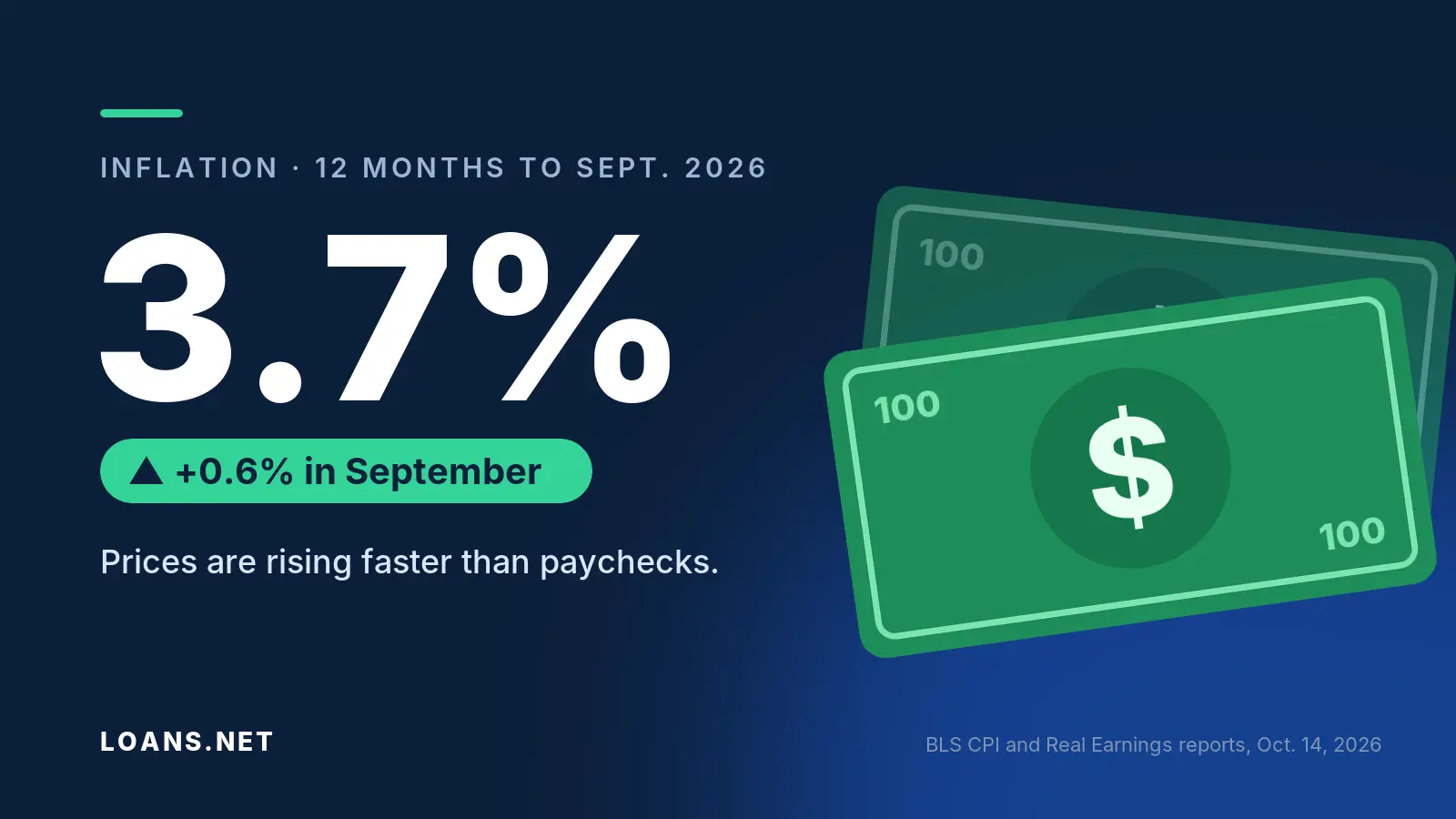
Your bills didn’t get bigger because you got careless. Prices rose 0.6% in September alone and 3.7% over the past year, according to the Bureau of Labor Statistics report released October 14, 2026, while real hourly pay fell 0.5% in the same month. If you’re short this month and wondering whether a loan to pay bills makes sense, here’s the plain answer.
A loan to pay bills can work when the shortfall is one-time and you can name the date it ends, and when you borrow at a fixed rate you can repay within about a year. If the gap shows up every month, a loan only delays it and adds a payment, so fix the budget first and borrow only as a bridge.
The rest of this guide shows you how to tell which situation you’re in, what borrowing $1,500 really costs across five common options, and what to try before you borrow at all.
What changed in October: prices up, paychecks down
The September consumer price index rose 0.6% for the month and 3.7% for the 12 months ending in September. Those are the figures the BLS published on October 14, 2026.
The same morning, the BLS real earnings report showed average hourly pay rose just 0.1% in nominal terms in September. After inflation, real hourly earnings fell 0.5% for the month and are down 0.7% from September 2025. In plain terms: the same paycheck buys less than it did a year ago.
Here’s what that looks like at home. Say your household spends $4,000 a month on everyday costs. A 3.7% rise adds about $148 a month, or roughly $1,776 a year, without you buying a single extra thing. (That’s an illustration using the national average. Your own increase depends on where you live and what you buy.)
Borrowing also got more expensive. The Federal Reserve raised its benchmark rate by a quarter point on September 16, to a range of 3.75% to 4%, and the prime rate that banks post sits at 7.00%. The Fed’s average for credit card rates at banks was 22.36% in its October 7 consumer credit release.
Write down your own number before you read further: how much are you short this month, and is that the first month it happened?
The one test that decides if a loan to pay bills makes sense
A loan can fix a gap. It can’t fix a shortfall. Knowing which one you have is the whole decision.
A gap has an end date you can point to. A car repair wiped out this month’s rent money. Your hours were cut for six weeks and are already back. A medical bill landed the same month as your annual insurance premium. The money is coming, it just isn’t here yet.
A shortfall repeats. Your fixed bills are higher than your take-home pay, and they’ll still be higher next month. That’s what the September numbers describe for many households: costs rising faster than wages.
Borrow for a shortfall and you get this month covered, then next month you’re short by the same amount plus a loan payment. That’s how a $1,500 problem becomes a $4,000 problem by spring.
Run the test honestly. Ask yourself:
- Will I be short again next month if nothing changes?
- Can I name the date the extra money comes back (a paycheck, a refund, the end of a one-time expense)?
- Could I cover a new monthly payment of about $150 on top of my current bills?
If you answered yes, no, no, a loan is the wrong tool right now. Skip to the section on what to try first. If you answered no, yes, yes, keep reading.
What borrowing $1,500 to pay bills really costs
The same $1,500 can cost you under $200 or more than $1,000 depending on where you get it. Here’s a worked example using one-year repayment where it applies.
Credit card at 22.36% (the Fed’s bank average). Pay it off over 12 months and the payment is about $141 a month, for about $188 in interest. That holds only if you actually make that payment. At the minimum payment, it drags on for years. And because most card rates are variable, a Fed hike raises your rate on the balance you already have.
Personal loan at 18% (illustrative, for good credit). Over 12 months the payment is about $138, and total interest is about $150. The rate is fixed, so it can’t rise later.
Personal loan at 30% with a 5% origination fee (illustrative, for fair or bad credit). Over 12 months the payment is about $146 and interest is about $255. The $75 fee is usually taken out of the loan, so you’d receive $1,425, not $1,500. Total cost: about $330. If you need the full $1,500 in hand, you’d have to borrow a bit more.
Payday loan. According to the Consumer Financial Protection Bureau, a typical two-week payday loan charges $15 per $100 borrowed, which works out to an APR of almost 400%. Payday loans are usually small, so take a $500 loan: the fee is $75 every two weeks. Roll it over for three months and you’ve paid $450 in fees and still owe the $500.
Credit union payday alternative loan (PAL). Federal credit unions can offer PALs under rules set by the National Credit Union Administration. PAL I loans run $200 to $1,000 over one to six months; PAL II loans go up to $2,000 over up to 12 months. The application fee is capped at $20, rollovers aren’t allowed, and the interest rate is capped by federal rule.
| Option | Example cost on $1,500 | Rate type | Credit needed | Main risk |
|---|---|---|---|---|
| Credit card at 22.36% (paid off in 12 months) | About $188 interest | Variable | Existing card with room | Rate can rise; minimum payments stretch it out for years |
| Personal loan at 18%, 12 months (illustrative) | About $150 interest | Fixed | Good | Adds a fixed monthly payment of about $138 |
| Personal loan at 30% + 5% fee, 12 months (illustrative) | About $330 interest and fee | Fixed | Fair to bad | Fee cuts the cash you receive |
| Payday loan, $500 rolled over 3 months | $450 in fees, $500 still owed | Flat fee, almost 400% APR | Little or none | Rollovers that never end |
| Credit union PAL (up to $1,000 or $2,000) | Capped rate, fee up to $20 | Fixed | Credit union membership | Small loan size; must join first |
Rates in the personal loan examples are illustrative. Your actual rate depends on your credit profile, income and the lender.
You can test your own numbers with the Loans.net loan calculator. Put in the amount you need and two or three rates, then look at total interest, not just the monthly payment.
Why the Fed’s October 27-28 meeting matters for how you borrow
If you’re going to borrow, a fixed rate protects you from the next hike. A variable rate doesn’t.
The Fed meets October 27-28. According to the minutes of the September meeting, most Fed officials thought another increase would likely be appropriate by the end of the year. Nobody knows what they’ll decide, and you shouldn’t borrow early just to beat a meeting.
Here’s the part that does matter. Credit card rates and most other variable-rate credit move with the prime rate, and prime moves with the Fed. If you put this month’s bills on a card and carry the balance into 2027, any hike lands on that balance. A fixed-rate personal loan locks your rate on the day you sign.
So if you’re comparing a card with a fixed-rate installment loan at a similar rate, pick the fixed rate for anything you can’t clear in two or three months.
Try these before you borrow a dime
The cheapest money is the money you don’t borrow. Call these places before you apply for anything:
- The company you owe. Utilities, hospitals, phone carriers and many landlords will set up a payment plan if you call before the due date. Ask: “Can you split this balance over three or four months with no late fee?”
- Your state’s energy assistance program. If heating or power bills are the problem, the federal Low Income Home Energy Assistance Program (LIHEAP) is run by each state. The federal LIHEAP contact list at acf.hhs.gov links to your state’s office, and in many states 211 can point you to it.
- Your employer. Some employers offer pay advances at no cost. Ask HR before you look at apps that charge “tips” or fees.
- Your credit union. If you belong to one, ask about a PAL or a small personal loan. If you don’t, PAL II rules let you apply as soon as you join.
- Your card issuer. If you already carry a balance, call and ask for a lower rate or a hardship program. It takes ten minutes and the worst answer is no.
Pick the one that fits your gap and make that call today, before the bill’s due date.
How to decide: who should borrow, and who should wait
Here’s how the decision usually breaks down by situation.
- Good credit (roughly 670+), one-time gap of $1,000 to $5,000: a fixed-rate personal loan is often the cleanest option. Choose the shortest term you can cover on a bad month.
- Fair or bad credit, one-time gap: compare a credit union PAL against personal loan offers for bad credit. Check the fee and the total cost, not the monthly payment.
- Gap you can close within one or two paychecks: a payment plan with the biller usually beats any loan. If you use a card, pay it off before the next statement closes.
- Short every month: don’t borrow. Cut or renegotiate a fixed bill first, then revisit. A loan here only adds a payment to a budget that’s already underwater.
- Thinking of a payday loan to pay off another loan: stop. That’s the cycle the CFPB warns about. Talk to a nonprofit credit counselor instead.
If you landed in one of the first two groups, compare offers before you commit to one.
Compare your options
Short for a one-time bill? See fixed-rate personal loan offers and compare total cost before you decide.
Loans.net is a marketplace, not a lender. Checking offers uses a soft credit check. Loans.net is paid by partners.
If you do borrow: five rules that keep it from getting worse
A loan to pay bills only works if it stays a one-time fix. These rules keep it that way.
- Borrow the exact gap, not a cushion. Every extra $500 at 30% costs about $85 in interest over a year.
- Pick a fixed rate and a term of 12 months or less if you can afford the payment. Longer terms lower the payment but raise the total cost.
- Check the APR, not just the interest rate. The APR includes the origination fee, so it’s the only number you can compare across offers.
- Set up autopay for the new payment the same day you sign. A missed payment adds a late fee and can lower your credit score.
- Write down how you’ll fill the gap next month. If you can’t, go back to the “try these first” list before you borrow again.
Checking offers through a marketplace uses a soft credit check, which doesn’t affect your score. A hard check happens only if you move forward with a specific lender’s application.
FAQ
Is it a good idea to get a loan to pay bills?
It can be, if the shortfall is one-time and you can repay within about a year at a fixed rate. If you’re short every month, a loan makes next month harder because you add a payment to the same budget.
What’s the cheapest way to borrow money to pay bills?
A payment plan with the company you owe usually costs nothing. After that, a 0% offer you can clear in time, a credit union PAL or a personal loan at a low fixed rate tends to cost far less than a payday loan, which the CFPB says typically runs almost 400% APR.
Can I get a personal loan to pay bills with bad credit?
Often, yes, but expect a higher rate and possibly an origination fee. Compare the total cost across several offers, and look at a credit union PAL if you belong to one.
Will borrowing to pay bills hurt my credit?
Checking offers with a soft credit check won’t. A formal application usually triggers a hard inquiry, which can cause a small, temporary dip. On-time payments help your score over time; missed payments hurt it.
Should I wait until after the Fed meeting to borrow?
No. Don’t time a loan around the Fed. If you need the money, borrow when you need it, at a fixed rate. If you don’t need it yet, don’t borrow at all.
This article is general education, not individual financial advice. Loans.net is a marketplace, not a lender, and doesn’t make credit decisions. Loans.net is paid by partners. For more on how the process works, see the Loans.net FAQ or our guide to personal loans.
Sources
- U.S. Bureau of Labor Statistics, Consumer Price Index, September 2026 (released Oct. 14, 2026)
- U.S. Bureau of Labor Statistics, Real Earnings, September 2026 (released Oct. 14, 2026)
- BLS, The Economics Daily: Real average hourly earnings decreased 0.7 percent, September 2025 to September 2026
- Federal Reserve, FOMC statement, Sept. 16, 2026
- Federal Reserve, Minutes of the FOMC, Sept. 15-16, 2026
- Federal Reserve, H.15 Selected Interest Rates (bank prime loan rate)
- Federal Reserve, G.19 Consumer Credit, Oct. 7, 2026 release
- CFPB, What are the costs and fees for a payday loan?
- HHS Administration for Children and Families, LIHEAP state and territory contact listing
- NCUA, Payday Alternative Loan rule