Written and reviewed by Yonni Rossa
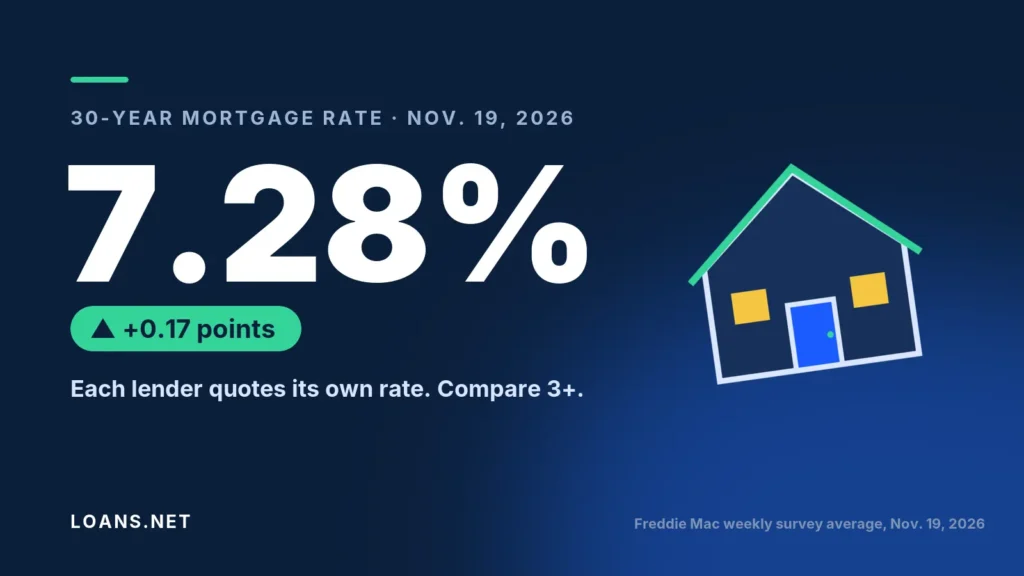
The average 30-year fixed mortgage rate jumped to 7.28% in Freddie Mac’s survey released November 19, 2026, up from 7.11% a week earlier and 6.26% a year ago. If you’re buying a home this winter, you can’t control which week rates land. You can control how many lenders you ask, which raises the obvious question: is mortgage rate shopping worth the effort?
Short answer: get at least three Loan Estimates, ideally four or five, all within the same 45-day window. At today’s rates, a quarter-point difference on a $320,000 loan is about $54 a month, roughly $650 a year, and about $19,500 over a full 30-year term. Collecting the quotes costs you a few evenings and, at most, a credit report fee for each lender.
Which brings us to one of the odder customs in American home buying: picking a lender first and comparing loans never.
Mortgage rates are 7.28% this week. What changed?
Rates rose 0.17 percentage points in a single week, so the price of a mortgage is moving faster than most buyers move. Freddie Mac’s Primary Mortgage Market Survey for November 19 put the 30-year fixed at 7.28% and the 15-year fixed at 6.66%, up from 6.45% the week before. A year ago the 30-year averaged 6.26%, a full point lower.
The Federal Reserve doesn’t set mortgage rates, but it sets the mood. Minutes of its October 27-28 meeting, released November 18, show the Fed held its target range at 3.75% to 4% on a 10-2 vote, with both dissenters wanting a quarter-point increase. The minutes say almost all participants judged that further increases would likely be appropriate in coming months. The next meeting is December 8-9.
None of that tells you where mortgage rates will be in January. It tells you that waiting for a better week is a bet, while comparing lenders this week is arithmetic. I prefer arithmetic.
Why do lenders quote different mortgage rates to the same borrower?
Lenders price the same borrower differently on the same day, and the gap gets wider when rates are high. Freddie Mac’s research team looked at this in February 2023. In 2022, rate dispersion, meaning the spread of rates offered to identical borrowers, more than doubled its 2010-2021 average of under 0.2 percentage points, to around 0.5 points. Freddie Mac estimated that borrowers who got two quotes could have saved as much as $600 a year in late 2022, and those who got four or more could have saved more than $1,200 a year.
Each lender has its own costs, its own appetite for loans that week, its own pricing adjustments for credit score and down payment, and its own idea of what a fair profit looks like. The posted “average rate” is just that: an average of a lot of numbers that disagree with each other.
Freddie Mac’s figures were for borrowers with FICO scores of 740 or higher putting at least 20% down. If your score is in the 600s, nobody can tell you in advance how far apart your quotes will land. The only way to find out is to collect them.
What a quarter point costs on a typical mortgage
On a $320,000, 30-year fixed loan, every quarter point is about $54 a month. Here’s the math with the current survey average as the starting line. All rates below are illustrative; your actual rate depends on your credit, down payment, loan type and the lender.
- At 7.28%, principal and interest come to about $2,189 a month. Over 30 years you’d pay about $468,200 in interest.
- At 7.03% (a quarter point lower), the payment is about $2,135. Lifetime interest drops to about $448,800.
- At 6.78% (half a point lower), the payment is about $2,082. Lifetime interest is about $429,500.
So the quarter point is worth about $54 a month, or $649 a year. The half point is worth about $108 a month, or $1,291 a year. Those numbers line up almost exactly with Freddie Mac’s $600 and $1,200 estimates from 2022, which is a nice coincidence and a useful sanity check.
Over 30 years the quarter point adds up to about $19,500 and the half point to about $38,700. Most people don’t keep a mortgage that long; they move or refinance. If you keep the loan seven years, the quarter point saves about $4,500 in payments, and the half point about $9,000.
I’ll admit that sitting at the kitchen table comparing three Loan Estimates is less fun than touring houses. It pays better than almost anything else you’ll do that month, though. Run your own numbers with the Loans.net mortgage calculator.
How many mortgage lenders should you compare?
Three quotes is the minimum worth doing, and four or five is better if you can manage it within a few days. Yet most people don’t do it. A CFPB survey of home buyers, published in January 2015, found that almost half seriously considered only one lender or broker, and about 77% applied with just one. Those figures are old, but nothing suggests the habit has gone away.
The reason more quotes help is basic statistics. With one quote, you get whatever that lender happened to offer. With two, you get the better of two. Each added quote raises the odds that one of them sits near the low end of the range, though the extra gain shrinks as you go. That’s why Freddie Mac’s estimate for four quotes was roughly double its estimate for two, not quadruple.
A practical mix for most buyers: your own bank or credit union, one online lender, one mortgage broker (who can shop several wholesale lenders for you), and one lender your real estate agent didn’t pick for you. That’s four different pricing engines.
Does rate shopping hurt your credit score?
Rate shopping inside a short window counts as one credit inquiry, not five. The CFPB says multiple credit checks from mortgage lenders within a 45-day window are recorded on your credit report as a single inquiry. Some older scoring models use a shorter window, as little as 14 days, so the safest plan is to collect every quote within two weeks.
Two things break that rule. Shopping for a mortgage and a car loan at the same time counts as two separate kinds of inquiry, so don’t stack them. And stretching your search over two or three months can turn one inquiry into several.
If you’re not sure where your score stands, check it before the first lender does. Our guide to credit scores explains what lenders look at, and how to improve your credit covers what you can still change in the 30-60 days before you apply.
How to compare Loan Estimates line by line
Compare the interest rate, the points, and Section A of the Loan Estimate together, never the rate alone. Under the CFPB’s rules, a lender must give you a Loan Estimate within three business days of receiving your application, and the only fee it can charge before that is for pulling your credit report, typically under $30.
The standard form makes side-by-side comparison easy if you know where to look. Here are three illustrative Loan Estimates for the same $320,000, 30-year fixed loan:
| Quote A | Quote B | Quote C | |
|---|---|---|---|
| Interest rate | 7.28% | 7.03% | 7.03% |
| Points | None | 1 point ($3,200) | None |
| Origination charges (Section A) | $1,500 | $1,500 | $2,600 |
| Monthly principal and interest | $2,189 | $2,135 | $2,135 |
| Upfront cost vs. Quote A | $0 | +$3,200 | +$1,100 |
| Break-even vs. Quote A | n/a | About 59 months | About 20 months |
Quote C wins for almost anyone: same rate as B, and the extra $1,100 in fees is paid back by the $54 monthly savings in about 20 months. Quote B is the interesting one. Paying $3,200 in points to save $54 a month takes about 59 months, nearly five years, to break even. If you think you’ll sell or refinance before then, the points lose money. Quote A looks cheapest at closing and is the most expensive loan on the page within two years.
On the real form, check four places: the interest rate and whether it’s locked (page 1), Section A for origination charges and points, Section B for services you can’t shop for, and the “Comparisons” box on page 3, which shows what you’ll have paid in total over five years.
Should you wait for mortgage rates to drop instead?
Waiting only makes sense if you don’t need to buy yet, because nobody can promise rates will fall. The Fed’s own minutes point toward more increases, not fewer, and the survey rate just moved 0.17 points in one week. That single weekly move is close to the quarter point you might save by shopping.
Turn that into a plan. Collect your quotes within a few days of each other so you’re comparing the same market. When you pick a lender, ask about locking the rate and how long the lock lasts. A lock protects you from the next jump in the survey; it doesn’t help with one that already happened.
For a buyer who can’t comfortably afford the payment at 7.28%, the answer changes. Don’t stretch to buy now and plan to refinance later. A refinance depends on rates actually falling and on your credit and home value holding up, and none of that is guaranteed. Saving a bigger down payment, or buying a cheaper house, is a less exciting but surer fix.
Who gains the most from mortgage rate shopping?
Borrowers with larger loans, longer plans to stay, and less-than-perfect credit tend to have the most at stake. The dollar savings scale with the loan amount: a quarter point on $500,000 is about $84 a month, on $200,000 about $34. And the longer you keep the loan, the more months the difference repeats.
Borrowers with fair credit should shop at least as hard as anyone else. Each lender applies its own credit-based pricing adjustments, and some offer FHA or other government-backed loans while others don’t, so the quotes have more ways to disagree. If one lender says no or quotes a rate far above the survey average, that’s one lender’s answer. Ask the next one.
Homeowners who already have a mortgage near 3% or 4% probably shouldn’t be shopping for a new first mortgage at all. If you need cash from your home, compare a home equity loan or HELOC against a cash-out refinance before you give up a low rate.
Your mortgage shopping plan for this week
- Pull your credit reports and check your score before any lender does.
- Decide your price range and down payment, so every lender quotes the same loan amount and loan type.
- Request Loan Estimates from three to five lenders within 14 days.
- Line them up: rate, points, Section A, and the five-year total on page 3.
- Ask the lender with the lowest total cost to lock, and ask the others whether they’ll beat it. Some may.
Compare your options
Rates moved 0.17 points in one week. One request lets you compare mortgage quotes from more than one lender.
Loans.net is a marketplace, not a lender. Checking offers uses a soft credit check. Loans.net is paid by partners.
Mortgage rate shopping FAQ
How many mortgage quotes should I get?
Get at least three, and four or five if you can. Freddie Mac estimated in 2023 that borrowers with four or more quotes could have saved about twice as much a year as borrowers with two. Keep all of them within 14 to 45 days so they count as one credit inquiry.
Is it bad to get multiple mortgage quotes?
No. The CFPB says mortgage credit checks within a 45-day window show up as a single inquiry on your credit report. The risk is stretching the search over months or mixing it with a car loan or credit card application.
How much can you save by shopping for a mortgage?
It depends on the spread of offers you get, which nobody can promise in advance. As an illustration, on a $320,000, 30-year loan, a 0.25-point lower rate saves about $54 a month, or roughly $650 a year, at today’s rates.
Do I have to pay for a Loan Estimate?
Only a credit report fee, if the lender charges one. Under CFPB rules, a lender can’t charge application or appraisal fees until you’ve received the Loan Estimate and said you want to go ahead.
Should I buy points to lower my mortgage rate?
Only if you’ll keep the loan past the break-even point. Divide the cost of the points by the monthly savings. In our example, $3,200 for $54 a month takes about 59 months. Sell or refinance sooner and the points cost more than they save.
For more on how the process works, see our mortgage guide.
Sources
- Freddie Mac, Primary Mortgage Market Survey, November 19, 2026
- Federal Reserve, Minutes of the FOMC, October 27-28, 2026 (released November 18, 2026)
- Freddie Mac, “When Rates Are Higher, Borrowers Who Shop Around Save More,” February 16, 2023
- CFPB, “Nearly half of mortgage borrowers don’t shop around when they buy a home”
- CFPB, Consumers’ mortgage shopping experience, January 2015
- CFPB, What happens when a mortgage lender checks my credit?
- CFPB, How much does it cost to receive a Loan Estimate?