The average 30-year fixed mortgage rate climbed to 7.28% in Freddie Mac’s weekly survey on October 1, 2026, up from 7.03% a week earlier and 6.34% a year ago. If you are under contract on a house, or close to it, this week’s question is a practical one: should you lock your mortgage rate now, or wait and hope it comes back down?
The short answer: if you have a closing date and you can afford the payment at today’s rate, locking is usually the safer move. A lock protects you if rates keep rising. Waiting only pays off if they fall, and nobody can promise you which way next week goes.
What happened to mortgage rates this week
Freddie Mac’s Primary Mortgage Market Survey also put the 15-year fixed at 6.60%, up from 6.42% the week before. The Mortgage Bankers Association’s own survey for the week ending September 25 found the 30-year conforming rate at 7.30%, its sixth weekly increase in a row and the highest since November 2023. That rate came with 0.75 points attached.
Borrowers noticed. MBA reported total mortgage applications down 6% that week, and refinance applications 56% below the same week a year earlier. The Federal Reserve isn’t helping either: on September 16 it raised its benchmark rate by a quarter point, to a range of 3.75% to 4%.
What 7.28% costs you, in plain arithmetic
Waiting for rates to drop has become something of a national hobby, like checking the weather app for a forecast that changes every time you open it. So before you decide whether to lock your mortgage rate, let’s put prices on it.
Take a $400,000, 30-year fixed loan. Monthly principal and interest works out to roughly:
- $2,486 at 6.34% (the average a year ago)
- $2,669 at 7.03% (the average one week earlier)
- $2,737 at 7.28% (the October 1 average)
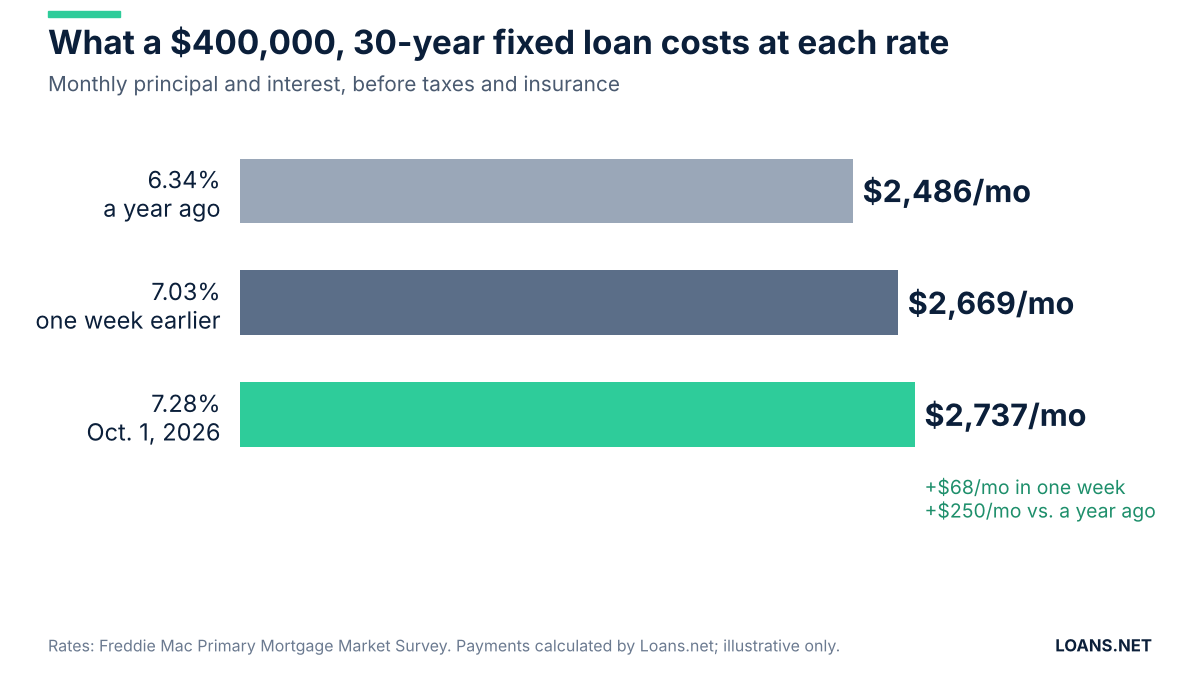
One week of rate movement added about $68 a month to that payment. Over the full 30 years, the 7.28% loan carries about $585,000 in interest, versus about $561,000 at 7.03%. That’s roughly $24,300 for the crime of signing seven days later. Compared with a year ago, the same loan costs about $250 more every month.
These figures are principal and interest only, before taxes and insurance, and the loan amount is an example. Your own rate depends on your credit, down payment and the lender. You can run your own numbers in the Loans.net mortgage calculator.
Should you lock your mortgage rate or wait?
A rate lock means your interest rate won’t change between the offer and closing, as long as you close within the lock period and nothing in your application changes. The Consumer Financial Protection Bureau says locks commonly run 30, 45 or 60 days, sometimes longer. It also names two downsides: extending a lock can be expensive, and a lock keeps you out of a lower rate if rates fall after you get your offer.
Here is how the bet looks on that $400,000 loan. If rates rise another quarter point to 7.53% before you close, your payment goes up about $68 a month. If they fall a quarter point, you save about the same. The odds look even, but the consequences aren’t. A lower rate later can sometimes be captured with a refinance (which has its own closing costs). A higher rate at closing can’t be undone, and it lands on a budget you already built around a specific payment.
So lock when you have an accepted offer, a realistic closing date and a payment that works. Waiting makes more sense when you have no house picked out, because a lock has nothing to attach to. In that case the useful kind of waiting is the kind where you improve your credit or add to your down payment, since both can lower the rate you’re offered no matter where the market goes.
Should you pay points to buy the rate down?
When you lock your mortgage rate, you lock a specific rate and points combination, so decide on points before you lock. One discount point costs 1% of the loan amount, so $4,000 on a $400,000 loan. Say one point lowers your rate by a quarter point, from 7.28% to 7.03%. That trade is an example only; lenders price points differently, so check your own Loan Estimate.
In that example the point saves about $68 a month. Divide $4,000 by $68 and you get about 59 months, just under five years, to break even. Keep the loan longer than that and the point pays for itself. Refinance in 18 months because rates dipped, and you’ve paid $4,000 for a lower rate you used for a year and a half. I like a lower rate as much as anyone, but not at that price.
What to do this week before you lock your mortgage rate
- Get Loan Estimates from at least three lenders. The CFPB says multiple mortgage credit checks within a 45-day window count as a single inquiry, so shopping inside that window won’t pile up damage to your score.
- Compare rate, points and lender fees side by side. A lower rate with 1.5 points can cost more than a slightly higher rate with none, depending on how long you keep the loan.
- Get the lock terms in writing. Ask how long the lock lasts and what an extension costs before you agree to it.
- Test your budget at 7.53%. If a quarter-point rise would break your monthly budget, the house is probably too expensive at today’s rates, and buying a cheaper home or waiting is the better choice.
- Don’t change anything before closing. A lock depends on your application staying the same, so hold off on new credit cards, car loans or a job change until you have the keys.
If you already own a home and were hoping to tap equity, a cash-out refinance at today’s rates means giving up your existing rate on the whole balance. Read our home equity guide before you do that.
Compare your options
Rates moved a quarter point in one week, so the gap between lenders’ offers matters more than usual: compare mortgage offers with one request.
Loans.net is a marketplace, not a lender. Checking offers uses a soft credit check. Loans.net is paid by partners.
FAQ
Why are mortgage rates going up?
Mortgage rates track longer-term borrowing costs in the bond market more closely than the Fed’s short-term rate, and both have been moving up. The Fed raised its benchmark range to 3.75% to 4% on September 16, 2026, and the 30-year mortgage average has climbed for six straight weeks in MBA’s survey.
How long does a mortgage rate lock last?
According to the CFPB, rate locks are typically 30, 45 or 60 days, and sometimes longer. If your closing slips past the lock date, extending it can cost extra, so ask for the extension terms up front.
Will shopping several mortgage lenders hurt my credit?
Not much, if you do it within a short window. The CFPB says multiple mortgage credit checks within 45 days are treated as one inquiry.
What happens if rates drop after I lock?
Once you lock your mortgage rate, you normally keep it even if the market falls. That’s the trade-off of a lock. Some lenders offer lock terms that allow a lower rate if the market falls, often at a cost, so ask before you lock rather than after.
Written and reviewed by Yonni Rossa
Sources
- Freddie Mac, “Mortgage Rates Average 7.28%,” Primary Mortgage Market Survey, October 1, 2026
- Freddie Mac Primary Mortgage Market Survey
- Mortgage Bankers Association, Weekly Applications Survey, week ending September 25, 2026 (released September 30, 2026)
- Federal Reserve, FOMC statement, September 16, 2026
- CFPB, “What’s a lock-in or a rate lock on a mortgage?”
- CFPB, “What happens when a mortgage lender checks my credit?”
Payment examples are illustrative and exclude taxes, insurance and fees. Loans.net is a loan marketplace, not a lender, and does not set rates or make credit decisions.